Pre-Terra Preta formulation improves forage quality of Pennisetum purpureum cv. Mott on marginal land

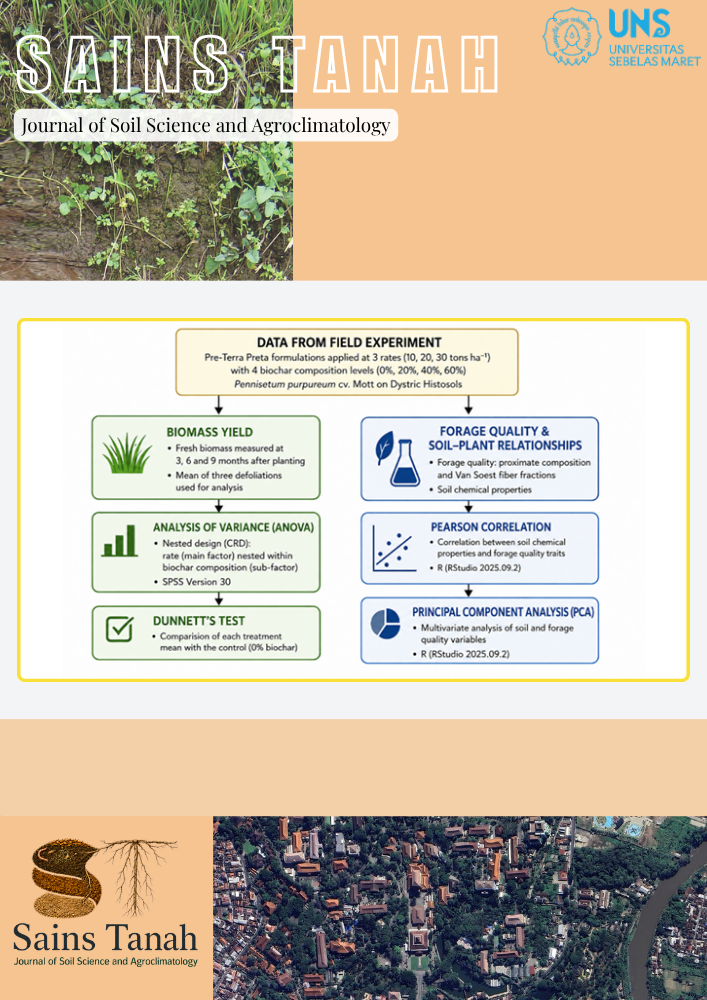
Marginal tropical soils, particularly Dystric Histosols, pose severe constraints for sustainable forage production due to their low fertility, poor nutrient retention, and low organic matter content. This study evaluated the effect of pre‑Terra Preta formulations (biochar combined with organic matter and microbial inoculants) on biomass yield and forage quality of Pennisetum purpureum cv. Mott in Dystric Histosols of South Kalimantan, Indonesia. Treatments consisted of pre-Terra Preta formulations containing 0%, 20%, 40% and 60% biochar within the formulation matrix (w/w), applied at rates of 10, 20, and 30 tons ha-1. Biomass yield was evaluated using nested ANOVA, whereas forage quality attributes (proximate composition, fiber fractions) and soil chemical properties were assessed using Pearson correlation and principal component analysis (PCA). Results demonstrated that biomass yield increased significantly only at ≥ 40% biochar, with the strongest effect observed at 60% biochar, producing nearly a fourfold increase relative to the control. Correlation analysis revealed strong internal coherence among fiber fractions and coordinated relationships among soil nutrient variables, while associations between soil chemical properties and forage quality traits were generally moderate. PCA further highlighted two dominant gradients: PC1 associated with structural fiber fractions, and PC2 reflecting soil fertility variables, underscoring the multivariate nature of soil–plant interactions. Overall, findings demonstrated that pre‑Terra Preta formulations substantially enhanced forage biomass productivity and influenced forage quality traits in marginal tropical soils. By identifying the threshold effect of ≥40% biochar and the optimal impact at 60%, this study provides practical guidance for rehabilitating degraded landscapes and strengthening the resilience of livestock systems in tropical regions.
1. INTRODUCTION
Marginal tropical soils, particularly Dystric Histosols, present severe constraints for sustainable forage production due to their low fertility, poor nutrient retention, and susceptibility to degradation. These soils are characterized by low cation exchange capacity, high acidity, and low organic matter content, which collectively limit their ability to sustain perennial grasses such as Pennisetum purpureum cv. Mott(Kurniawan et al., 2022). This forage species, widely cultivated in Southeast Asia, is a cornerstone of livestock feeding systems, providing high biomass yields under favorable conditions. However, in degraded landscapes dominated by Imperata cylindrica, productivity is severely compromised, threatening both forage availability and nutritional quality. Addressing these challenges requires soil management strategies that not only enhance biomass yield but also improve forage quality to support animal nutrition and overall livestock system resilience(Siddiqui, 2025).
One promising approach is the application of biochar‑enriched amendments, inspired by the ancient Amazonian Dark Earths (Terra Preta). Biochar, a carbon‑rich product derived from biomass pyrolysis, has attracted global attention for its multifunctional role in soil improvement(Hoque et al., 2025). Its porous structure and chemical stability enable it to act as a long‑term carbon sink while simultaneously enhancing soil nutrient retention, cation exchange capacity, and microbial activity(Ganesh et al., 2025). However, the magnitude and direction of these effects depend on biochar feedstock characteristics and production conditions, which influence its physicochemical properties. Biochar with favorable physicochemical characteristics, including alkaline pH, porous structure, and strong nutrient-retention capacity, is often considered particularly suitable for tropical soils, where nutrient leaching and poor structural stability are persistent problems. By improving soil physical and chemical properties, biochar can contribute to both immediate agronomic benefits and long‑term environmental sustainability(Siddiqui, 2025).
Recent studies emphasize that biochar integration into tropical agroecosystems can significantly improve soil fertility and plant productivity. For example, biochar has been shown to increase soil organic carbon stability, enhance phosphorus availability, and reduce nutrient losses through leaching(Babu et al., 2025). These improvements directly support sustained plant growth and nutrient use efficiency. Moreover, the role of biochar in enhancing water retention is particularly relevant for marginal lands, where conventional fertilizers often fail to deliver lasting improvements due to rapid nutrient depletion and poor soil structure(Eissa et al., 2025). In tropical forage systems, these benefits translate into higher biomass yields and improved resilience against climatic variability.
Building upon this foundation, the concept of pre‑Terra Preta formulations represents an innovative adaptation of traditional knowledge to modern agricultural contexts. Inspired by the processes that created Terra Preta soils in the Amazon, these formulations combine biochar with organic matter and microbial inoculants to generate synergistic effects (Evans, 2022;Lehmann & Joseph, 2024;Neina & Agyarko-Mintah, 2023). Ancient Terra Preta soils remain fertile for centuries due to their high carbon content and stable nutrient pools, offering a model for sustainable soil management. By mimicking these processes, pre‑Terra Preta formulations are immature forms of biochar-rich amendments that aim to create resilient soil systems that enhance both biomass yield and forage quality (Melo & Sánchez-Monedero, 2024;Murtaza et al., 2023;Ramezanzadeh et al., 2023).
Previous studies have examined the role of biochar in improving soil fertility and plant productivity, but they have not clearly identified the threshold proportion of biochar within pre-Terra Preta formulations required to significantly enhance forage biomass yield and quality in marginal soils such as Dystric Histosols(Nasution et al., 2025). This gap is critical because marginal tropical soils are characterized by severe nutrient limitations, low organic matter content, and poor structural stability, which collectively constrain sustainable forage production. Addressing these constraints requires integrated pre-Terra Preta formulations that combine biochar, organic matter, and microbial inoculants to stabilize soil fertility and improve forage quality. The novelty of this study lies in establishing the threshold effect of biochar within pre‑Terra Preta formulations for forage systems. By systematically testing different biochar proportions within pre-Terra Preta (0 – 60%), this research provides new empirical evidence that a specific application rate and formulation of pre-Terra Preta can rehabilitate marginal soil and strengthen tropical livestock systems.
This study, therefore, seeks to examine the role of pre‑Terra Preta formulations in enhancing biomass yield and forage quality of Pennisetum purpureum cv. Mott cultivated on marginal soils in South Kalimantan, Indonesia. By integrating soil chemistry, proximate composition, and fiber fraction analyses, the research provides empirical evidence for the effectiveness of biochar‑enriched amendments in tropical forage production. The study further employs correlation and PCA to elucidate the multivariate relationships linking soil fertility variables with forage quality traits, thereby offering a holistic perspective on soil–plant interactions. Ultimately, the findings contribute to the broader discourse on sustainable soil management and livestock system resilience in degraded tropical landscapes. By demonstrating that significant yield improvements occur only at ≥ 40% biochar, with 60% biochar offering the most pronounced benefits, the study highlights the importance of targeted amendment strategies. These insights not only advance scientific understanding but also provide practical guidance for rehabilitating marginal lands and strengthening tropical livestock systems.
2. MATERIALS AND METHODS
2.1. Site Description and Sampling
The field experiment was conducted at the Jorong Livestock Community Academy, Tanah Laut Regency, South Kalimantan, Indonesia (114°58’1.352” E; – 4°0’30.009” S) (Fig. 1). The site is located in a tropical humid climate zone with annual rainfall ranging from 2,182 to 2,454 mm. According to the World Reference Base for Soil Resources
Downloads
Antonangelo, J. A., Culman, S., & Zhang, H. (2024). Comparative analysis and prediction of cation exchange capacity via summation: influence of biochar type and nutrient ratios [Original Research]. Frontiers in Soil Science, Volume 4 - 2024. https://doi.org/10.3389/fsoil.2024.1371777
Babu, C. S., Jyothsna, P. V., Taj, S. T., Sohil, M., & Kamarimath, V. (2025). Biochar and its role in soil fertility enhancement and carbon sequestration strategies. International Journal of Research in Agronomy, 8(7). https://doi.org/10.33545/2618060X.2025.v8.i7l.3307
Baquy, M. A.-A., Mamun, M. A. A., Mia, S., Alam, M. M., Khan, M. S. H., & Rahman, S. M. (2022). Biochar research advancement in Bangladesh: challenges and opportunities of biochar in improving soil health. SAINS TANAH - Journal of Soil Science and Agroclimatology, 19(2), 15. https://doi.org/10.20961/stjssa.v19i2.59758
Bhandari, K. B., Rusch, H. L., & Heuschele, D. J. (2023). Alfalfa Stem Cell Wall Digestibility: Current Knowledge and Future Research Directions. Agronomy, 13(12), 2875. https://doi.org/10.3390/agronomy13122875
DeLuca, T. H., Gundale, M., MacKenzie, M. D., Gao, S., & Jones, D. (2024). Biochar effects on soil nutrient transformations. In Biochar for environmental management. Taylor & Francis. https://doi.org/10.4324/9781003297673-16
Dixon, R. A., Puente-Urbina, A., Beckham, G. T., & Román-Leshkov, Y. (2024). Enabling Lignin Valorization Through Integrated Advances in Plant Biology and Biorefining. Annual Review of Plant Biology, 75(Volume 75, 2024), 239-263. https://doi.org/10.1146/annurev-arplant-062923-022602
Eissa, R. O., Jeyakumar, L., McKenzie, D. B., & Wu, J. (2025). Improving Soil Fertility and Forage Production Using Spruce Bark Biochar in an Eastern Newfoundland Podzolic Soil. Nitrogen, 6(3), 83. https://doi.org/10.3390/nitrogen6030083
Evans, K. (2022). The Nutrient-Rich Legacy in the Amazon’s Dark Earths. https://eos.org/features/the-nutrient-rich-legacy-in-the-amazons-dark-earths
Ganesh, M., Shanurasab, K., & Yadahalli, V. (2025). Advances in biochar applications for enhancing soil fertility and carbon sequestration. International Journal of Research in Agronomy, 8(7), 171-177. https://doi.org/10.33545/2618060X.2025.v8.i7c.3194
Gaurav, S., Diptanu, B., Mehta, C. M., Prasann, K., Nishihara, E., Inubushi, K.,…Rajput, V. D. (2025). Effects of biochar amendment at various soil depths on maize roots and growth indices. Scientific Reports, 15(1), 26310. https://doi.org/10.1038/s41598-025-09218-1
Haghighatnia, H., Talebi, E., & Khosravi Nezhad, M. (2024). Enhancing peppermint growth: Investigating the interplay of Biochar and Nitrogen levels [Biochar; Biochemical compounds; Elemental concentrations; Growth indicators; Nitrogen]. SAINS TANAH - Journal of Soil Science and Agroclimatology, 21(2), 11. https://doi.org/10.20961/stjssa.v21i2.89008
Hoque, M. M., Saha, B. K., Scopa, A., & Drosos, M. (2025). Biochar in Agriculture: A Review on Sources, Production, and Composites Related to Soil Fertility, Crop Productivity, and Environmental Sustainability. C, 11(3), 50. https://doi.org/10.3390/c11030050
IUSS Working Group WRB. (2022). World Reference Base for Soil Resources. International soil classification system for naming soils and creating legends for soil map (4th ed.). International Soil Reference and Information Centre (ISRIC). Food and Agriculture Organization of the United Nations. https://openknowledge.fao.org/server/api/core/bitstreams/bcdecec7-f45f-4dc5-beb1-97022d29fab4/content
Katoch, R. (2023). Forage Quality Components. In Techniques in Forage Quality Analysis (pp. 17-32). Springer Nature Singapore. https://doi.org/10.1007/978-981-19-6020-8_4
Kurniawan, W., Hardianto, Ramdani, A., Bain, A., Bachtiar, T., & Wahyono, T. (2022). Influences of Manure and Biochar on Biomass Yield and Nutrient Value of Pennisetum Purpureum Cv. Mott Grown on Post-Nickel-Mining Soil. Journal of Animal and Plant Sciences, 32(5), 1306-1316. https://doi.org/10.36899/JAPS.2022.5.0537
Larsen, S. U., Manevski, K., Lærke, P. E., & Jørgensen, U. (2024). Biomass yield, crude protein yield and nitrogen use efficiency over nine years in annual and perennial cropping systems. European Journal of Agronomy, 161, 127336. https://doi.org/10.1016/j.eja.2024.127336
Latawiec, A. E., Rodrigues, A. F., Korys, K. A., Mendes, M., Rangel, M., Castro, A.,…Neto, E. C. d. S. (2023). Biochar and Forage Peanut improve pastures: Evidence from a field experiment in Brazil. Agriculture, Ecosystems & Environment, 353, 108534. https://doi.org/10.1016/j.agee.2023.108534
Lehmann, J., & Joseph, S. (2024). Biochar for environmental management: science, technology and implementation. Taylor & Francis. https://doi.org/10.4324/9781003297673
Lima, J. Z., & da Penha Simon, C. (2025). Biochar–soil–plant interfaces: a systematic review of the crop performance in tropical climate. International Journal of Environmental Science and Technology, 22(3), 1995-2020. https://doi.org/10.1007/s13762-024-05854-8
Luo, K., Xie, C., Yuan, X., Liu, S., Chen, P., Du, Q.,…Yang, W. (2023). Biochar and biofertilizer reduced nitrogen input and increased soybean yield in the maize soybean relay strip intercropping system. BMC Plant Biology, 23(1), 38. https://doi.org/10.1186/s12870-023-04058-5
Main, O., López-Malvar, A., Meunier, F., Guillaume, S., Jacquemot, M.-P., Lopez-Marnet, P.-L.,…Méchin, V. (2025). Targeting enhanced digestibility: Prioritizing low pith lignification to complement low p-coumaric acid content as environmental stress intensity increases. PLOS ONE, 20(12), e0338077. https://doi.org/10.1371/journal.pone.0338077
Melo, L. C. A., & Sánchez-Monedero, M. Ã. (2024). How biochar-based fertilizers and biochar compost affect nutrient cycling and crop productivity. Nutrient Cycling in Agroecosystems, 128(3), 411-414. https://doi.org/10.1007/s10705-024-10358-5
Murtaza, G., Ahmed, Z., Eldin, S. M., Ali, B., Bawazeer, S., Usman, M.,…Tariq, A. (2023). Biochar-Soil-Plant interactions: A cross talk for sustainable agriculture under changing climate [Review]. Frontiers in Environmental Science, Volume 11 - 2023. https://doi.org/10.3389/fenvs.2023.1059449
Nair, R. R., Kißling, P. A., Marchanka, A., Lecinski, J., Turcios, A. E., Shamsuyeva, M.,…Weichgrebe, D. (2023). Biochar synthesis from mineral and ash-rich waste biomass, part 2: characterization of biochar and co-pyrolysis mechanism for carbon sequestration. Sustainable Environment Research, 33(1), 14. https://doi.org/10.1186/s42834-023-00176-9
Nasution, D. P., Udiansyah, U., Razie, F., Syarifuddin, N. A., & Neina, D. (2025). Application of pre-Terra Preta to enhance soil fertility and productivity of marginal land cultivated with Pennisetum purpureum cv. Mott. SAINS TANAH - Journal of Soil Science and Agroclimatology, 22(2), 11. https://doi.org/10.20961/stjssa.v22i2.105965
Neina, D., & Agyarko-Mintah, E. (2023). The Terra Preta Model soil for sustainable sedentary yam production in West Africa. Heliyon, 9(5). https://doi.org/10.1016/j.heliyon.2023.e15896
Neina, D., & Glaser, B. (2024). Terra Preta production from Ghanaian and Zambian soils using domestic wastes. Scientific Reports, 14(1), 24197. https://doi.org/10.1038/s41598-024-75521-y
Ramezanzadeh, H., Zarehaghi, D., Baybordi, A., Bouket, A. C., Oszako, T., Alenezi, F. N., & Belbahri, L. (2023). The Impacts of Biochar-Assisted Factors on the Hydrophysical Characteristics of Amended Soils: A Review. Sustainability, 15(11), 8700. https://doi.org/10.3390/su15118700
Siddiqui, S. (2025). Unlocking the environmental potential of biochar: production, applications, and limitations [Review]. Frontiers in Sustainable Food Systems, Volume 9 - 2025. https://doi.org/10.3389/fsufs.2025.1569941
Tedeschi, L. O., Adams, J. M., & Vieira, R. A. M. (2023). Forages and Pastures Symposium: revisiting mechanisms, methods, and models for altering forage cell wall utilization for ruminants. Journal of Animal Science, 101. https://doi.org/10.1093/jas/skad009
Van Soest, P. J. (1994). Nutritional Ecology of the Ruminant (2nd ed.). Cornell University Press. http://www.jstor.org/stable/10.7591/j.ctv5rf668
Van Soest, P. J., Robertson, J. B., & Lewis, B. A. (1991). Methods for Dietary Fiber, Neutral Detergent Fiber, and Nonstarch Polysaccharides in Relation to Animal Nutrition. Journal of Dairy Science, 74(10), 3583-3597. https://doi.org/10.3168/jds.S0022-0302(91)78551-2
Yang, Y., Ahmed, W., Ye, C., Yang, L., Wu, L., Dai, Z.,…Zhao, Z. (2024). Exploring the effect of different application rates of biochar on the accumulation of nutrients and growth of flue-cured tobacco (Nicotiana tabacum) [Original Research]. Frontiers in Plant Science, Volume 15 - 2024. https://doi.org/10.3389/fpls.2024.1225031
Zhang, S., Yang, Y., Zhang, Y., Chen, C., Liang, Z., Sun, D.,…Zhang, F. (2026). Unraveling the law of element coupling effects on DRX behavior in low-alloy steels: A PCA-based study with XGBoost prediction. Journal of Materials Science & Technology, 260, 162-173. https://doi.org/10.1016/j.jmst.2025.09.050
Zhang, Y., Hwarari, D., Yang, Y., Huo, A., Wang, J., & Yang, L. (2022). Biochar-Induced Mitigation Potential of Greenhouse Gas Emissions Was Enhanced under High Soil Nitrogen Availability in Intensively-Irrigated Vegetable Cropping Systems. Agronomy, 12(10), 2249. https://doi.org/10.3390/agronomy12102249
- Authors retain copyright and grant the journal right of first publication with the work simultaneously licensed under a Creative Commons Attribution-NonCommercial License that allows others to Share (copy and redistribute the material in any medium or format) and Adapt (remix, transform, and build upon the material) the work non-commercially with an acknowledgement of the work's authorship and initial publication in this journal.
- Authors are able to enter into separate, additional contractual arrangements for the non-exclusive distribution of the journal's published version of the work (e.g., post it to an institutional repository or publish it in a book), with an acknowledgement of its initial publication in this journal.
- Authors are permitted and encouraged to post their work online (e.g., in institutional repositories or on their website) prior to and during the submission process, as it can lead to productive exchanges, as well as earlier and greater citation of published work (See The Effect of Open Access).