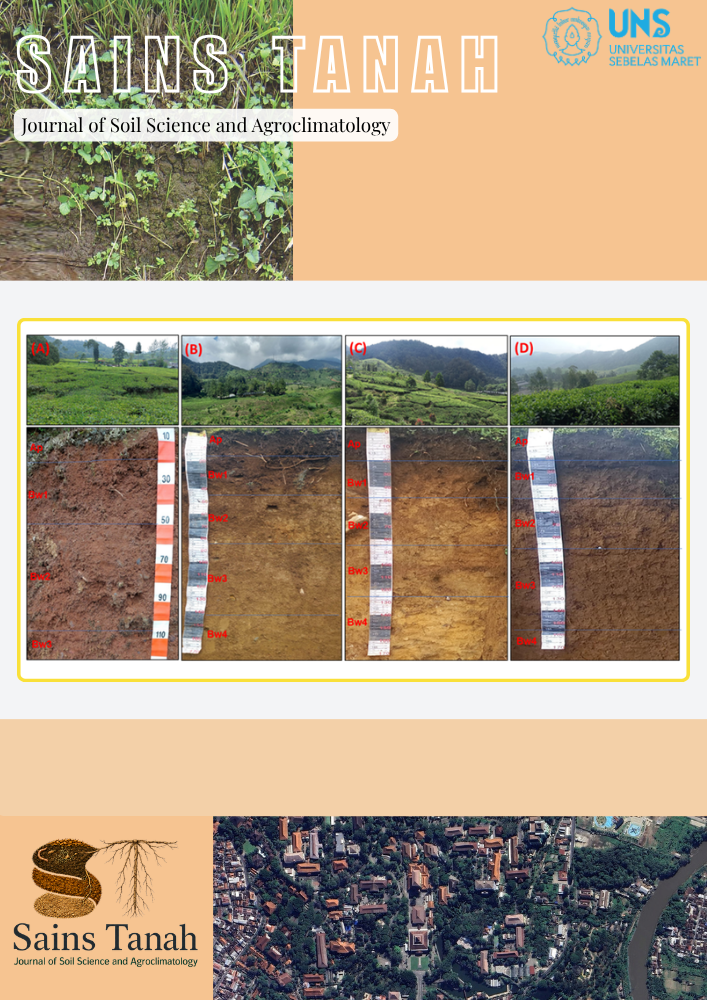
Andosols property dynamics under intensive tea cultivation in West Java: Implications for sustainable management

Downloads
Downloads
Ahmadi Mirghaed, F., & Souri, B. (2022). Effect of landscape fragmentation on soil quality and ecosystem services in land use and landform types. Environmental Earth Sciences, 81(12), 330. https://doi.org/10.1007/s12665-022-10454-1
Alatas, A., & Wan Sulong, W. S. (2020). The Emergence and Development of Indigenous Tea Plantations in West Java, 1875–1941. KEMANUSIAAN The Asian Journal of Humanities, 27(2), 39–58. https://doi.org/10.21315/kajh2020.27.2.3
Anda, M., & Dahlgren, R. A. (2020). Long-term response of tropical Andisol properties to conversion from rainforest to agriculture. CATENA, 194, 104679. https://doi.org/10.1016/j.catena.2020.104679
Anindita, S., Sleutel, S., Vandenberghe, D., De Grave, J., Vandenhende, V., & Finke, P. (2022). Land use impacts on weathering, soil properties, and carbon storage in wet Andosols, Indonesia. Geoderma, 423, 115963. https://doi.org/10.1016/j.geoderma.2022.115963
Anjarsari, I. R. D., Hamdani, J. S., Suherman, C., Nurmala, T., Syahrian, H., Rahadi, V., & Rezamela, E. (2019). Pengaruh pemangkasan dan aplikasi sitokinin terhadap pertumbuhan dan hasil tanaman teh (Camelia sinensis) [Effect of Pruning and Cytokinin Application on the Growth and Yield of Tea (Camellia sinensis)]. Jurnal Tanaman Industri dan Penyegar, 6(2), 61-63. https://repository.pertanian.go.id/handle/123456789/11070
Anjarsari, I. R. D., Wiharti, N. R., & Maxiselly, Y. (2024). Optimizing biofertilizer application and fertilizing technique for enhanced tea plant growth and flavonoid composition after drought season. Research on Crops, 25(4). https://doi.org/10.31830/2348-7542.2024.ROC-1105
Arif, M., Ikramullah, Jan, T., Riaz, M., Akhtar, K., Ali, S., . . . Wang, H. (2021). Biochar and leguminous cover crops as an alternative to summer fallowing for soil organic carbon and nutrient management in the wheat-maize-wheat cropping system under semiarid climate. Journal of Soils and Sediments, 21(3), 1395-1407. https://doi.org/10.1007/s11368-020-02866-y
Arifin, M., Devnita, R., Anda, M., Goenadi, D. H., & Nugraha, A. (2022). Characteristics of Andisols Developed from Andesitic and Basaltic Volcanic Ash in Different Agro-Climatic Zones. Soil Systems, 6(4), 78. https://doi.org/10.3390/soilsystems6040078
Azurianti, A., Wulansari, R., Athallah, F. N. F., & Prijono, S. (2022). Kajian Hubungan Hara Tanah terhadap Produktivitas Tanaman Teh Produktif di Perkebunan Teh Pagar Alam, Sumatera Selatan [Study of the Relationship Between Soil Nutrients and the Productivity of Mature Tea Plants at the Pagar Alam Tea Plantation, South Sumatra]. JTSL (Jurnal Tanah dan Sumberdaya Lahan), 9(1), 153-161. https://doi.org/10.21776/ub.jtsl.2022.009.1.17
Beckstrom, T. B., Maaz, T. M., Deenik, J. L., Peter-Contesse, H., Koch, A., Tallamy Glazer, C., . . . Crow, S. E. (2025). From volcanic ash to abundant earth: understanding Andisol organic matter dynamics in relation to soil health on Hawaiʻi Island. Biogeochemistry, 168(2), 22. https://doi.org/10.1007/s10533-025-01216-9
BPS. (2023). Kabupaten Bogor Dalam Angka 2023 [Bogor Regency in Figures 2023]. Badan Pusat Statistik Kabupaten Bogor (Statistics of Bogor Regency). https://bogorkab.bps.go.id/id/publication/2023/02/28/ecc46f13dd34e43cfc1ffbdc/kabupaten-bogor-dalam-angka-2023.html
Braak, C. (1929). The Climate of The Netherlands Indies. Verhandelingen, 8(1602).
Brust, G. E. (2019). Chapter 9 - Management Strategies for Organic Vegetable Fertility. In D. Biswas & S. A. Micallef (Eds.), Safety and Practice for Organic Food (pp. 193-212). Academic Press. https://doi.org/10.1016/B978-0-12-812060-6.00009-X
Buurman, P. (1990). Chemical, physical, and mineralogical characteristics for the soil data base. https://research.wur.nl/en/publications/chemical-physical-and-mineralogical-characteristics-for-the-soil-/
Churchman, G. J., & Lowe, D. J. (2012). Alteration, formation, and occurrence of minerals in soils. In P. M. Huang, Y. Li, & M. E. Sumner (Eds.), Handbook of Soil Sciences: Properties and Processes (2nd ed.). CRC press.
Dexter, A. R. (2004). Soil physical quality: Part I. Theory, effects of soil texture, density, and organic matter, and effects on root growth. Geoderma, 120(3), 201-214. https://doi.org/10.1016/j.geoderma.2003.09.004
Effendi, A. C., Kusnama, & Hermanto, B. (1998). Peta Geologi Lembar Bogor, Jawa Barat.
Effendi, D. S., Syakir, M., Yusron, M., & Wiratno. (2010). Budidaya dan Pascapanen Teh [Tea Cultivation and Postharvest Handling]. Pusat Penelitian dan Perkembangan Perkebunan. Bogor. https://repository.pertanian.go.id/server/api/core/bitstreams/08191407-1bdd-41e8-a6a3-f699f5b0903a/content
Eviati, Sulaeman, Herawaty, L., Anggria, L., Usman, Tantika, H. E., . . . Wuningrum, P. (2023). Analisis Sifat Kimia Tanah, Jaringan Tanaman, Air, dan Pupuk [Analysis of Soil Chemical Properties, Plant Tissue, Water, and Fertilizers] (3rd ed.). Soil Research Institute , Agricultural Research And Development Agency, Agricultural Ministry of Indonensia. https://repository.pertanian.go.id/handle/123456789/23044
Febriantika, P. T., Athallah, F. N. F., Wulansari, R., & Suprayogo, D. (2022). Hubungan Antara Perbedaan Kelas Kelerengan dengan Karakteristik Kimia Tanah pada Perkebunan Teh Jolotigo Lingkup PTPN IX [Relationship Between Differences in Slope Classes and Soil Chemical Characteristics in the Jolotigo Tea Plantation under PTPN IX]. JTSL (Jurnal Tanah dan Sumberdaya Lahan), 9(1), 171-179. https://doi.org/10.21776/ub.jtsl.2022.009.1.19
Fiantis, D., Rudiyanto, Gusnidar, Ginting, F. I., Padrikal, R., Prayoga, D., . . . Nelson, M. (2023). Carbon and Phosphorus in Volcanic Soils of Mt. Kerinci (Sumatra) After Long Term Tea and Paddy Cultivation. Communications in Soil Science and Plant Analysis, 54(22), 3169-3184. https://doi.org/10.1080/00103624.2023.2253843
Fukumasu, J., Jarvis, N., Koestel, J., Kätterer, T., & Larsbo, M. (2022). Relations between soil organic carbon content and the pore size distribution for an arable topsoil with large variations in soil properties. European Journal of Soil Science, 73(1), e13212. https://doi.org/10.1111/ejss.13212
Hafif, B. (2020). Kerusakan tanah pada lahan perkebunan dan strategi pencegahan serta penanggulangannya [Soil Deterioration of Plantation Land and Strategies for Its Prevention and Handling]. Perspektif, 19(2), 105-121. https://www.researchgate.net/publication/349119457
Harefa, D. (2025). The Influence of Soil Texture Types on Land Resilience to Drought in South Nias. Jurnal Sapta Agrica, 4(1). https://doi.org/10.57094/jsa.v4i1.2585
Heryana, N., & Rokhmah, D. N. (2021). Estimated Stored Carbon Stock in Tea Plantation at Various Elevation. Jurnal Tanah dan Iklim, 45(2), 155-162. https://epublikasi.pertanian.go.id/berkala/jti/article/view/3281
Hu, J., Ci, E., Li, S., Lian, M., & Zhong, S. (2021). The Pedogenesis of Soil Derived from Carbonate Rocks along a Climosequence in a Subtropical Mountain, China. Forests, 12(8), 1044. https://doi.org/10.3390/f12081044
Huang, P. M., & Wang, M. K. (2005). Minerals, Primary. In D. Hillel (Ed.), Encyclopedia of Soils in the Environment (pp. 500-510). Elsevier. https://doi.org/10.1016/B0-12-348530-4/00464-1
Ishak S, M., Sudarsono, Widiatmaka, & Yahya, S. (2017). Tea Plantation Dynamic in West Java Based on Productivity and Institutional Research [Land conversion, Tea Plantation, Tea Production, Indonesia Tea Export, Institutional Role]. 2017, 7. https://doi.org/10.29313/mimbar.v33i1.2315
IUSS Working Group WRB. (2015). World reference base for soil resources 2014. International soil classification system for naming soils and creating legends for soil maps (Update 2015). World Soil Resources Reports No. 106. FAO, Rome. https://isric.org/explore/wrb
Jiang, P., Ding, W., Yuan, Y., & Ye, W. (2020). Diverse response of vegetation growth to multi-time-scale drought under different soil textures in China's pastoral areas. Journal of Environmental Management, 274, 110992. https://doi.org/10.1016/j.jenvman.2020.110992
Kurnia, U., Agus, F., Adimihardja, A., Rachman, A., Sutono, S., Santri, J. A., & Ariani, R. (2022). Sifat Fisika Tanah dan Metode Analisisnya [Soil Physical Properties and Their Methods of Analysis] (2nd ed.). Center for Agricultural Land Resources Research and Development https://repository.pertanian.go.id/handle/123456789/22009
Le, V. S., Herrmann, L., Bräu, L., & Lesueur, D. (2023). Sustainable green tea production through agroecological management and land conversion practices for restoring soil health, crop productivity and economic efficiency: Evidence from Northern Vietnam. Soil Use and Management, 39(3), 1185-1204. https://doi.org/10.1111/sum.12885
Li, L., Chen, L., Li, H., Xia, Y., Wang, H., Wang, Q., . . . Wang, B. (2025). Slope Position Modulates Soil Chemical Properties and Microbial Dynamics in Tea Plantation Ecosystems. Agronomy, 15(3), 538. https://doi.org/10.3390/agronomy15030538
Lyu, H., Sakai, K., Toyota, K., Hayashi, H., Morigasaki, S., Tanaka, H., & Sugihara, S. (2025). Long-term NPK fertilization enhances microbial carbon use efficiency in Andosols by alleviating P limitation and shifting microbial strategies. Environmental Research, 277, 121598. https://doi.org/10.1016/j.envres.2025.121598
Manumono, D., & Listiyani. (2023). Kajian Perkembangan Teh di Indonesia [A Review of Tea Development in Indonesia]. AGRIFITIA : Journal of Agribusiness Plantation, 2(2), 133-146. https://doi.org/10.55180/aft.v2i2.281
Marianti, Pulungan, N. A. H. J., & Gunadi, R. (2021). The effect of slope and altitude on soil characteristics in tea plantation area, Central Java, Indonesia. International Journal of Agriculture, Forestry and Plantation, 12, 154-160. https://ijafp.org/wp-content/uploads/2023/11/IJAFP12-069.pdf
Muslim, R. Q. (2024). Pengaruh Perubahan Penggunaan Lahan terhadap Karakteristik Tanah dan Stabilitas Bahan Organik pada Tanah Vulkanik [Master’s thesis, IPB University]. https://repository.ipb.ac.id/handle/123456789/135736
Muslim, R. Q., Suryaningtyas, D. T., Subiksa, I. G. M., & Mulyanto, B. (2024). Karakteristik Mineral Pasir Tanah Vulkanik Sebagai Cadangan Hara Untuk Meningkatkan Produktivitas Tanah. Prosiding Seminar Teknologi Pertanian Indonesia (STPI). https://prosiding-stpi.ub.ac.id/index.php/stpi2023/article/view/67
Muslim, R. Q., Suryaningtyas, D. T., Subiksa, I. G. M., & Mulyanto, B. (2025). Effect of land use change on soil chemical properties in Gede-Pangrango volcanic soil, West Java, Indonesia [Article]. Songklanakarin Journal of Science and Technology, 47(1), 8-15. https://www.scopus.com/inward/record.uri?eid=2-s2.0-105001951745&partnerID=40&md5=a7784771b6d1fbb2a05b66735d753975
Prasetyo, B., Suharta, N., & Yatno, E. (2009). Karakteristik Tanah-Tanah Bersifat Andik dari Bahan Piroklastis Masam di Dataran Tinggi Toba [Characteristics of Andic Soils Derived from Acidic Pyroclastic Materials in the Toba Highlands]. Jurnal Tanah dan Iklim, 29(2009), 1-14. https://repository.pertanian.go.id/server/api/core/bitstreams/8c1269f3-afc0-464c-962a-b0ece694cd60/content
Pratiwi, S. A., & Andriyani, D. (2021). Pengaruh Luas Lahan Teh dan Produktivitas Teh terhadap Ekspor Teh di Indonesia Tahun 1985 sampai 2019 [The Influence of Tea Plantation Area and Tea Productivity on Tea Exports in Indonesia from 1985 to 2019]. Jurnal Ekonomi Pertanian Unimal, 4(1), 29-37. https://doi.org/10.29103/jepu.v4i1.4436
Ramadhan, I., Devnita, R., & Arifin, M. (2023). Assessing Pruning Intensity to Improve the Tea Productivity in Tropical Plantations by Multispectral Image Classification Model Using K-Means Algorithm. International Journal of Plant & Soil Science, 35(23), 464–473. https://doi.org/10.9734/ijpss/2023/v35i234263
Ritung, S., Nugroho, K., Mulyani, A., & Suryani, E. (2011). Petunjuk Teknis Evaluasi Lahan untuk Komoditas Pertanian [Technical Guidelines for Land Evaluation for Agricultural Commodities]. Indonesian Center for Agricultural Land Resources Research and Development (BBSDLP).
Schmidt, F., & Ferguson, J. (1951). Rainfall types based on wet and dry period ratios for Indonesia with Western New Guinea. Verhandelingen, Djawatan Meteorologi dan Geofisik, Djakarta(No. 42), 77. https://www.cabidigitallibrary.org/doi/full/10.5555/19510600016
Siahaan, A. J., Irsal, & Sitorus, B. (2024). The Relationship between Climate and Productivity of Tea Plants (Camellia sinensis L.) in Bah-Butong Gardens PT. Perkebunan Nusantara IV, North Sumatra Province in 2005-2009. Jurnal Online Pertanian Tropik, 11(2), 1-8. https://doi.org/10.32734/jopt.v11i2.17559
Soil Survey Staff. (2022). Keys to Soil Taxonomy. Natural Resources Conservation Service, U.S. Department of Agriculture. https://www.nrcs.usda.gov/sites/default/files/2022-09/Keys-to-Soil-Taxonomy.pdf
Subardja, D., Ritung, S., Anda, M., Sukarman, Suryani, E., & Subandiono, R. E. (2014). Petunjuk Teknis Klasifikasi Tanah Nasional [Technical Guidelines for National Soil Classification]. Balai Besar Penelitian dan Pengembangan Sumberdaya Lahan Pertanian. https://repository.pertanian.go.id/handle/123456789/20639
Sukarman, Ritung, S., Anda, M., & Suryani, E. (2017). Pedoman Pengamatan Tanah di Lapangan [Guidelines for Field Soil Observation]. IAARD Press. https://repository.pertanian.go.id/handle/123456789/20124
Surbakti, E., & Irsal. (2024). The Influence of Climate on Tea Crop Productivity (Camellia sinensis L.) in the Bah Butong plantation 2000-2004. JURNAL AGROTEKNOLOGI, 12(1), 1-6. https://doi.org/10.32734/ja.v12i1.18758
Takeda, M., Nakamoto, T., Miyazawa, K., Murayama, T., & Okada, H. (2009). Phosphorus availability and soil biological activity in an Andosol under compost application and winter cover cropping. Applied Soil Ecology, 42(2), 86-95. https://doi.org/10.1016/j.apsoil.2009.02.003
Tan, K. H. (1965). The andosols in Indonesia. Soil Science, 99(5). http://repository.ipb.ac.id/handle/123456789/28517
Umiyati, U., Kurniadie, D., & Fakhriah, R. L. (2024). Effectiveness of glyphosate potassium 660 g/L herbicide in controlling weeds at productive tea plants (Camellia sinensis (L.) O. Kuntze). Research on Crops, 25(1). https://doi.org/10.31830/2348-7542.2024.ROC-1027
van Wambeke, A. (1982). Calculated Soil Moisture and Temperature Regimes of Africa. Soil Conservation Service, USDA.
Vidana Gamage, D. N., Peiris, T., Kasthuriarachchi, I., Mohotti, K. M., & Biswas, A. (2025). Enhancing Soil Resilience to Climate Change: Long-Term Effects of Organic Amendments on Soil Thermal and Physical Properties in Tea-Cultivated Ultisols. Sustainability, 17(3), 1184. https://doi.org/10.3390/su17031184
Wahyudin, D. (1989). Sifat-Sifat Tanah, Tingkat Pelapukan, Pedogenesis dan Klasifikasi Andosol Menurut Taksonomi Tanah pada Suatu Transek Lereng di Perkebunan Teh Gunung Mas/Cikopo Selatan, PTP XII, Cisarua Bogor [Under, IPB University]. http://repository.ipb.ac.id/handle/123456789/30253
Wang, D., Liu, B., Li, F., Wang, Z., Hou, J., Cao, R., . . . Yang, W. (2025). Status and influential factors of soil nutrients and acidification in Chinese tea plantations: a meta-analysis. SOIL, 11(1), 175-191. https://doi.org/10.5194/soil-11-175-2025
Wang, M., Zhao, J., Chen, J., Zhang, X., & Zhu, S. (2024). Soil Organic Carbon Content and Its Relationship with the Stand Age in Tea Plantations (Camellia sinensis L.) in Fujian Province, China. Land, 13(6), 834. https://doi.org/10.3390/land13060834
Weil, R. R., & Brady, N. C. (2016). The Nature and Properties of Soils. Pearson Education.
Wibisono, M. G., Sudarsono, S., & Darmawan, D. (2016). Karakteristik andisol berbahan induk breksi dan lahar dari bagian timur laut Gunung Gede, Jawa Barat [Characteristics of Andesols Derived from Breccia and Lahar Parent Materials from the Northeastern Part of Mount Gede, West Java]. Jurnal Tanah dan Iklim, 40(1), 61-70. https://epublikasi.pertanian.go.id/berkala/jti/article/view/3164
Wulanningtyas, H. S., Gong, Y., Li, P., Sakagami, N., Nishiwaki, J., & Komatsuzaki, M. (2021). A cover crop and no-tillage system for enhancing soil health by increasing soil organic matter in soybean cultivation. Soil and Tillage Research, 205, 104749. https://doi.org/10.1016/j.still.2020.104749
Wulansari, R., Athallah, F. N. F., & Pramudita, A. A. (2022). Effect of slope and year of pruning of tea plants on soil water content in Indonesian tea plantations [journal article]. Soil Science Annual, 73(4), 1-7. https://doi.org/10.37501/soilsa/157103
Wulansari, R., & Huga, A. (2024). Analisis pengaruh topografi lereng dan waktu pemangkasan terhadap kesuburan tanah di perkebunan teh, Jawa Barat [Analysis of the Effects of Slope Topography and Pruning Time on Soil Fertility in Tea Plantations, West Java]. Jurnal Pengelolaan Perkebunan (JPP), 5(2), 74-80. https://ojs.polteklpp.ac.id/index.php/JPP/article/view/64
Wulansari, R., & Pranoto, E. (2018). Degradasi bahan organik di beberapa perkebunan teh di Jawa Barat [Analysis of the Effects of Slope Topography and Pruning Time on Soil Fertility in Tea Plantations, West Java]. Jurnal Penelitian Teh dan Kina, 21(2), 57-64. https://tcrjournal.com/index.php/tcrj/article/view/144
Wulansari, R., Pranoto, E., & Saragih, J. (2022). Karakteristik sifat fisik andisols typic melanudands pada beberapa kemiringan lereng di perkebunan teh gambung, Jawa barat [Physical Characteristics of Typic Melanudands Andisols across Different Slope Gradients in the Gambung Tea Plantation, West Java]. Jurnal Pengelolaan Perkebunan (JPP), 3(1). https://doi.org/10.54387/jpp.v3i1.11
Yatno, E., Hikmat, M., & Suryani, E. (2021). Micromorphological characteristics of soils developed on volcanic ash in Lembang area, West Java, Indonesia. IOP Conference Series: Earth and Environmental Science, 648(1), 012005. https://doi.org/10.1088/1755-1315/648/1/012005
Ye, J., Wang, Y., Wang, Y., Hong, L., Jia, X., Kang, J., . . . Wang, H. (2022). Improvement of soil acidification in tea plantations by long-term use of organic fertilizers and its effect on tea yield and quality [Original Research]. Frontiers in Plant Science, Volume 13 - 2022. https://doi.org/10.3389/fpls.2022.1055900
Zhu, R., Zheng, Z., Li, T., Zhang, X., He, S., Wang, Y., . . . Li, W. (2017). Dynamics of soil organic carbon mineralization in tea plantations converted from farmland at Western Sichuan, China. PLOS ONE, 12(9), e0185271. https://doi.org/10.1371/journal.pone.0185271
- Authors retain copyright and grant the journal right of first publication with the work simultaneously licensed under a Creative Commons Attribution-NonCommercial License that allows others to Share (copy and redistribute the material in any medium or format) and Adapt (remix, transform, and build upon the material) the work non-commercially with an acknowledgement of the work's authorship and initial publication in this journal.
- Authors are able to enter into separate, additional contractual arrangements for the non-exclusive distribution of the journal's published version of the work (e.g., post it to an institutional repository or publish it in a book), with an acknowledgement of its initial publication in this journal.
- Authors are permitted and encouraged to post their work online (e.g., in institutional repositories or on their website) prior to and during the submission process, as it can lead to productive exchanges, as well as earlier and greater citation of published work (See The Effect of Open Access).