Spatial distribution of soil organic carbon along topographic gradients in the Ejido Adolfo Ruiz Cortines, Durango, Mexico

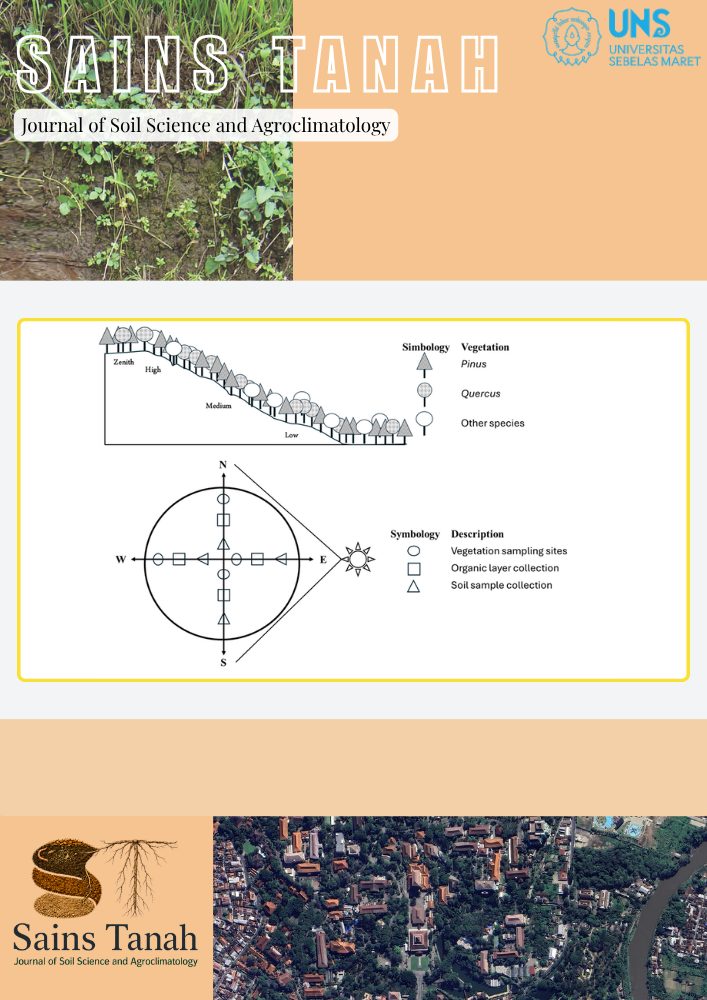
Temperate forests are key to regulating climate and biogeochemical cycles. Specifically, forest management in these ecosystems favors the fixation and storage of carbon in the soil, reducing the concentration of atmospheric carbon dioxide (CO2). The objective of this research was to analyze the distribution of soil organic carbon stored along a slope in different orientations in a temperate forest under management in the Ejido Adolfo Ruiz Cortines de Durango, Mexico. The factor analyzed was the orientation and position of the slopes. For orientation, slopes with North, South, East, and West orientations were selected, the position of each slope was divided into three sections: low, medium, and high slope, and a zenith area. On each slope, humus and leaf litter stocks were measured, and soil samples were collected to determine bulk density (Bd), soil porosity (P), soil moisture content (M), soil organic matter (SOM), and soil organic carbon (SOC). The carbon storage capacity was significantly influenced by slope orientation. In this sense, the SOC had the following trend: South (73.70 Mg ha-1) >North (73.12 Mg ha-1) >East (67.23 Mg ha-1) >West (54.09 Mg ha-1) >Zenith (47.75 Mg ha-1). Regarding the position, the upper part of the slope had the highest content (83.66 Mg ha-1), while the middle and lower parts had the lowest accumulation with 57.31 Mg ha-1 and 60.13 Mg ha-1, respectively. The orientation and position directly influenced the SOC reservoirs, being key to the productivity of the ecosystem, benefiting local producers.
1. INTRODUCTION
Temperate forests are important since they provide multiple goods and services essential for human beings and life on the planet in general; particularly, they are key in the regulation of climate and biogeochemical cycles. Specifically, forest management in these ecosystems favors the fixation and storage of carbon in the soil, reducing the concentration of atmospheric carbon dioxide (CO2) due to changes in environmental conditions, vegetation structure, and composition(Terrer et al., 2021). The importance of carbon in the soil results in the fact that it improves the availability of nutrients and improves soil fertility and structure, being key to the productivity of forest ecosystems(Gerke, 2022).
Soil stores a greater amount of carbon (1500 pg); Buczko et al. (2023) indicate that one square meter of forest land stores about 15 kg of C. In particular, soil humidity and temperature, leaf litter, root distribution, and soil microbiology can be modified depending on the intensity and the felling or practice carried out on the forest mass(Buraka et al., 2022); which directly impacts soil carbon stocks(Mushinski et al., 2017). However, this sequestration capacity can also vary due to various factors such as climate, precipitation, temperature, and solar energy, as well as species composition and site-specific conditions(Buczko et al., 2023).
Reed et al. (2021) point out that soil can be a sink or a source of carbon; this is a function of perturbation and changes in land use that break the carbon cycle. Therefore, it is important to analyze what factors are responsible for storage, allowing global climate change to be mitigated. In this sense, Lefèvre et al. (2017) point out that the factors that control the decomposition of SOM are soil temperature and water content, which significantly influence the storage of C in the soil due to their effect on microbial activity, and in turn the microbiological composition. The amount of SOC stored in the soil depends on the balance between the amount of C entering the soil and leaving the soil as gases. From microbial mineralization, C can also be lost or gained through soil erosion or deposition, leading to the redistribution of C from the soil on a local, landscape, and regional scale.
In Mexico, there is a great variability of climatic, geomorphological, and edaphological conditions, resulting in a wide diversity of habitats and species(Herrera-Romero et al., 2020). The quantity, quality, and distribution of organic carbon in the soil depend on the interaction of climatic, edaphic, topographic, and biological factors. Specifically, topography plays an important role in defining soil properties with respect to temperature and moisture regimes and is considered to be one of the main soil-forming factors since hillside position, slope, and orientation are important factors in soil formation and can affect soil moisture content. plant growth and distribution of SOC(Jakšić et al., 2021)(Zhang et al., 2023).
On the slopes, sequences of soils are formed with different characteristics between depth and texture. In the upper part of the slope, shallow soils of coarse texture are formed due to the erosive processes of the surface soil. The low slopes are characterized by the formation of deeper soils with fine textures and differentiated profiles. This is associated with higher concentrations of SOC on lower slopes due to soil deposition from the dragging of dead plant material (branches and leaves) from the upper part. On the other hand, orientation plays an important role on slopes Jakšić et al. (2021) and Maheshwori et al. (2025) point out that north-facing slopes receive less direct sunlight, storing more SOC in the soil, unlike south-facing slopes that are warmer and drier and present more sparse vegetation. and therefore, the accumulation of SOC in minor. However, it has been documented that the East orientation stores a greater amount of SOC compared to the North and West orientations(Niu et al., 2022).
Understanding the spatial dynamics of the SOC on a slope is important to identify areas of vulnerability to climate change, which are more prone to erosion and soil degradation due to their relief. Most research assesses slopes as a whole(Buraka et al., 2022)(Jakšić et al., 2021)(Maheshwori et al., 2025)(Niu et al., 2022), however, the dynamics within a slope change in the areas that make it up, for example: the upper areas of the slopes are more vulnerable to losing SOC due to sediment dragging, the lower part is benefited by the accumulation of organic matter, this is very common in agricultural areas, But in a poorly managed forest ecosystem, the dynamics could change by implementing proper management practices. According to Jakšić et al. (2021) and Leal et al. (2023), areas under forest management reduce cover by modifying soil properties depending on the intensity of management practices. Therefore, the objective was to analyze the distribution of soil organic carbon stored along a slope in different orientations in a temperate forest under management in the Ejido Adolfo Ruiz Cortines in Northwest Mexico, belonging to the mountain massif of the Sierra Madre Occidental.
2. MATERIAL AND METHODS
2.1. Description of the study area
The experiment was conducted in May 2025 in an area located southwest of Durango, Mexico, in the Sierra Madre Occidental. Specifically, in the ejido Adolfo Ruiz Cortines, between coordinates 23°44'48.43" N and 105°18′17.03′′W, presenting a temperate subhumid and semi-cold subhumid climate, with rainfall in
Downloads
Ameray, A., Bergeron, Y., Valeria, O., Montoro Girona, M., & Cavard, X. (2021). Forest Carbon Management: a Review of Silvicultural Practices and Management Strategies Across Boreal, Temperate and Tropical Forests. Current Forestry Reports, 7(4), 245-266. https://doi.org/10.1007/s40725-021-00151-w
Buczko, U., Cruz-GarcÃa, R., Harmuth, J., Kalbe, J., Scharnweber, T., Stoll, A., . . . Jurasinski, G. (2023). Soil and vegetation factors affecting carbon storage in a coastal forest in NE Germany. Geoderma Regional, 33, e00629. https://doi.org/10.1016/j.geodrs.2023.e00629
Buraka, T., Elias, E., & Lelago, A. (2022). Soil organic carbon and its' stock potential in different land-use types along slope position in Coka watershed, Southern Ethiopia. Heliyon, 8(8), e10261. https://doi.org/10.1016/j.heliyon.2022.e10261
Cano-Flores, O., Vela-Correa, G., Acevedo-Sandoval, O. A., & Valera-Pérez, M. Ã. (2020). Organic carbon concentrations in the woodland and soils of the protected natural area “El Faro†in Tlalmanalco, Estado de Mexico. REVISTA TERRA LATINOAMERICANA, 38(4), 895-905. https://doi.org/10.28940/terra.v38i4.757
Egli, M., Sartori, G., Mirabella, A., Favilli, F., Giaccai, D., & Delbos, E. (2009). Effect of north and south exposure on organic matter in high Alpine soils. Geoderma, 149(1), 124-136. https://doi.org/10.1016/j.geoderma.2008.11.027
GarcÃa Gallegos, E., Vázquez Cuecuecha, O. G., Guerra-De la Cruz, V., & Cocoletzi Pérez, F. J. (2023). Evaluación del efecto de obras de conservación en suelos forestales de Tlaxcala, México. Revista Mexicana de Ciencias Forestales, 14(78), 34-57. https://doi.org/10.29298/rmcf.v14i78.1385
Gautam, J., & Shapkota, J. (2025). Relationship Between Crown Density and Soil Organic Carbon Levels in Protected Forests of Midhills of Nepal. ESS Open Archive, 2025(0111). https://doi.org/10.22541/essoar.173655648.80813139/v1
Gerenfes, D., Giorgis, A., & Negasa, G. (2022). Comparison of organic matter determination methods in soil by loss on ignition and potassium dichromate method. International Journal of Horticulture and Food Science, 4(1), 49-53. https://doi.org/10.33545/26631067.2022.v4.i1a.85
Gerke, J. (2022). The Central Role of Soil Organic Matter in Soil Fertility and Carbon Storage. Soil Systems, 6(2), 33. https://doi.org/10.3390/soilsystems6020033
Haile, G., Gebru, C., Lemenih, M., & Agegnehu, G. (2024). Soil property and crop yield responses to variation in land use and topographic position: Case study from southern highland of Ethiopia. Heliyon, 10(3), e25098. https://doi.org/10.1016/j.heliyon.2024.e25098
Hao, H., Wang, R., Li, S., Pian, D., Peng, N., Sailike, A., . . . Zhang, W. (2025). Different contributions of microbial and plant residues to soil organic carbon accumulation during planted forest and abandoned farmland restoration, Loess Plateau, China. Plant and Soil, 507(1), 845-862. https://doi.org/10.1007/s11104-024-06772-x
Herrera-Romero, J., Bojórquez-Serrano, J., Hernández-Jiménez, A., & Can-Chulim, A. (2020). Geomorfoedaphological landscapes and regularities of soil distribution in San Blas Nayarit, Mexico. Revista bio ciencias, 7. https://doi.org/10.15741/revbio.07.e706
Jakšić, S., Ninkov, J., Milić, S., Vasin, J., Živanov, M., Jakšić, D., & Komlen, V. (2021). Influence of Slope Gradient and Aspect on Soil Organic Carbon Content in the Region of Niš, Serbia. Sustainability, 13(15), 8332. https://doi.org/10.3390/su13158332
Kashyap, B., & Kumar, R. (2021). Sensing Methodologies in Agriculture for Soil Moisture and Nutrient Monitoring. IEEE Access, 9, 14095-14121. https://doi.org/10.1109/ACCESS.2021.3052478
Khalid, M., Khalil, S., Abid, M., Hussain, T., Rafay, M., & Madnee, M. (2025). Quantifying Soil Organic Carbon in Arid Ecosystem Using Geospatial Tools: A Case Study of Protected Areas in Bahawalpur district, Punjab, Pakistan. Egyptian Journal of Soil Science, 65(3), 1383-1403. https://doi.org/10.21608/ejss.2025.380697.2149
Leal, F., Aburto, F., Aguilera, N., EcheverrÃa, C., & Gatica-Saavedra, P. (2023). Forest degradation modifies litter production, quality, and decomposition dynamics in Southern temperate forests [Original Research]. Frontiers in Soil Science, Volume 3 - 2023. https://doi.org/10.3389/fsoil.2023.1111694
Lefèvre, C., Rekik, F., Alcantara, V., & Wiese, L. (2017). Soil organic carbon: the hidden potential. Food and Agriculture Organization (FAO) of the United Nations. https://openknowledge.fao.org/handle/20.500.14283/i6937en
Luna Robles, E. O., Cantú-Silva, I., & Bejar Pulido, S. J. (2023). Soil Organic Carbon Changes in an Umbrisol under Different Silvicultural Treatments in a Temperate Forest in Northwestern Mexico. Journal of Sustainable Forestry, 42(4), 368-383. https://doi.org/10.1080/10549811.2022.2043904
Luna Robles, E. O., Hernandez, F. J., Cantu Silva, I., Bejar Pulido, S. J., & Dominguez Gomez, T. G. (2024). Sequence of Soil Organic Carbon through the Silvicultural Development Method (MDS) in temperate forests of Durango, Mexico. Egyptian Journal of Soil Science, 64(3), 731-738. https://doi.org/10.21608/ejss.2024.271685.1729
Maheshwori, D., Managave, S. R., Jathar, G., & Davande, S. (2025). Southeast and Northeast facing slopes have the Least Tree Cover in Northern and Southern Tropics, respectively. bioRxiv, 2025.2006.2005.658062. https://doi.org/10.1101/2025.06.05.658062
Muche, M., Yemata, G., Molla, E., Adnew, W., & Muasya, A. M. (2025). Soil nutrients, carbon and nitrogen stocks dynamics following exclosure in the North-eastern highlands of Ethiopia. Environmental Monitoring and Assessment, 197(5), 573. https://doi.org/10.1007/s10661-025-14025-2
Mushinski, R. M., Boutton, T. W., & Scott, D. A. (2017). Decadalâ€scale changes in forest soil carbon and nitrogen storage are influenced by organic matter removal during timber harvest. Journal of Geophysical Research: Biogeosciences, 122(4), 846-862. https://doi.org/10.1002/2016JG003738
Niu, Z., Li, C., Shi, Y., Chen, G., Mei, T., Zhou, Y., . . . Zhou, G. (2022). Topography Significantly influences the Growth Dynamics of Moso Bamboo Along a 10-year Chrono Sequence Following Afforestation. Journal of Sustainable Forestry, 41(2), 193-211. https://doi.org/10.1080/10549811.2020.1845745
Pardo-Plaza, Y. J., Paolini Gómez, J. E., & Cantero-Guevara, M. E. (2019). Biomasa microbiana y respiración basal del suelo bajo sistemas agroforestales con cultivos de café [Microbial biomass and basal soil respiration under agroforestry systems with coffee crops]. Revista UDCA Actualidad & Divulgación CientÃfica, 22(1). https://doi.org/10.31910/rudca.v22.n1.2019.1144
Rawlik, M., Kasprowicz, M., Jagodziński, A. M., Rawlik, K., & Kaźmierowski, C. (2019). Slope exposure and forest stand type as crucial factors determining the decomposition rate of herbaceous litter on a reclaimed spoil heap. CATENA, 175, 219-227. https://doi.org/10.1016/j.catena.2018.12.008
Reed, C. C., Merrill, A. G., Drew, W. M., Christman, B., Hutchinson, R. A., Keszey, L., . . . Sullivan, B. W. (2021). Montane Meadows: A Soil Carbon Sink or Source? Ecosystems, 24(5), 1125-1141. https://doi.org/10.1007/s10021-020-00572-x
Robinson, D. A., Thomas, A., Reinsch, S., Lebron, I., Feeney, C. J., Maskell, L. C., . . . Cosby, B. J. (2022). Analytical modelling of soil porosity and bulk density across the soil organic matter and land-use continuum. Scientific Reports, 12(1), 7085. https://doi.org/10.1038/s41598-022-11099-7
Roni, S. M., & Djajadikerta, H. G. (2021). Data analysis with SPSS for survey-based research. Springer. https://doi.org/10.1007/978-981-16-0193-4
Schad, P. (2023). World Reference Base for Soil Resources—Its fourth edition and its history. Journal of plant nutrition and soil science, 186(2), 151-163. https://doi.org/10.1002/jpln.202200417
Segura-Castruita, M. A., Sánchez-Guzmán, P., Ortiz-Solorio, C. A., & del Carmen Gutiérrez-Castorena, M. (2005). Carbono orgánico de los suelos de México. Terra Latinoamericana, 23(1), 21-28. https://terralatinoamericana.org.mx/index.php/terra/issue/view/70/15
Silva-González, E., ColÃn, J. G., Aguirre-Calderón, O., Treviño-Garza, E., Corral-Rivas, J., & Manzanilla-Quijada, G. (2024). Diversidad y estructura de especies arbóreas en tres tipos de vegetación forestal al sur de Durango, México [Diversity and structure of tree species in three types of forest vegetation in southern Durango, Mexico]. POLIBOTÃNICA(58). https://doi.org/10.18387/polibotanica.58.7
Staszel, K., Błońska, E., & Lasota, J. (2021). Slope aspect and altitude effect on selected soil organic matter characteristics in Beskid Mountains forest soils. Folia Forestalia Polonica, 63(3), 214-224. https://doi.org/10.2478/ffp-2021-0022
Tapia-Coronado, J. J., Contreras, J. L., MartÃnez-Atencia, J., López, L., & RodrÃguez, J. L. (2022). Production and decomposition of leaf litter from forest species in silvopastoral systems, Valle del Sinu, Colombia. AgronomÃa Mesoamericana, 34(1), 49781. https://doi.org/10.15517/am.v34i1.49781
Terrer, C., Phillips, R. P., Hungate, B. A., Rosende, J., Pett-Ridge, J., Craig, M. E., . . . Jackson, R. B. (2021). A trade-off between plant and soil carbon storage under elevated CO2. Nature, 591(7851), 599-603. https://doi.org/10.1038/s41586-021-03306-8
Zhang, J., Lan, Z., Li, H., Jaffar, M. T., Li, X., Cui, L., & Han, J. (2023). Coupling effects of soil organic carbon and moisture under different land use types, seasons and slope positions in the Loess Plateau. CATENA, 233, 107520. https://doi.org/10.1016/j.catena.2023.107520
- Authors retain copyright and grant the journal right of first publication with the work simultaneously licensed under a Creative Commons Attribution-NonCommercial License that allows others to Share (copy and redistribute the material in any medium or format) and Adapt (remix, transform, and build upon the material) the work non-commercially with an acknowledgement of the work's authorship and initial publication in this journal.
- Authors are able to enter into separate, additional contractual arrangements for the non-exclusive distribution of the journal's published version of the work (e.g., post it to an institutional repository or publish it in a book), with an acknowledgement of its initial publication in this journal.
- Authors are permitted and encouraged to post their work online (e.g., in institutional repositories or on their website) prior to and during the submission process, as it can lead to productive exchanges, as well as earlier and greater citation of published work (See The Effect of Open Access).