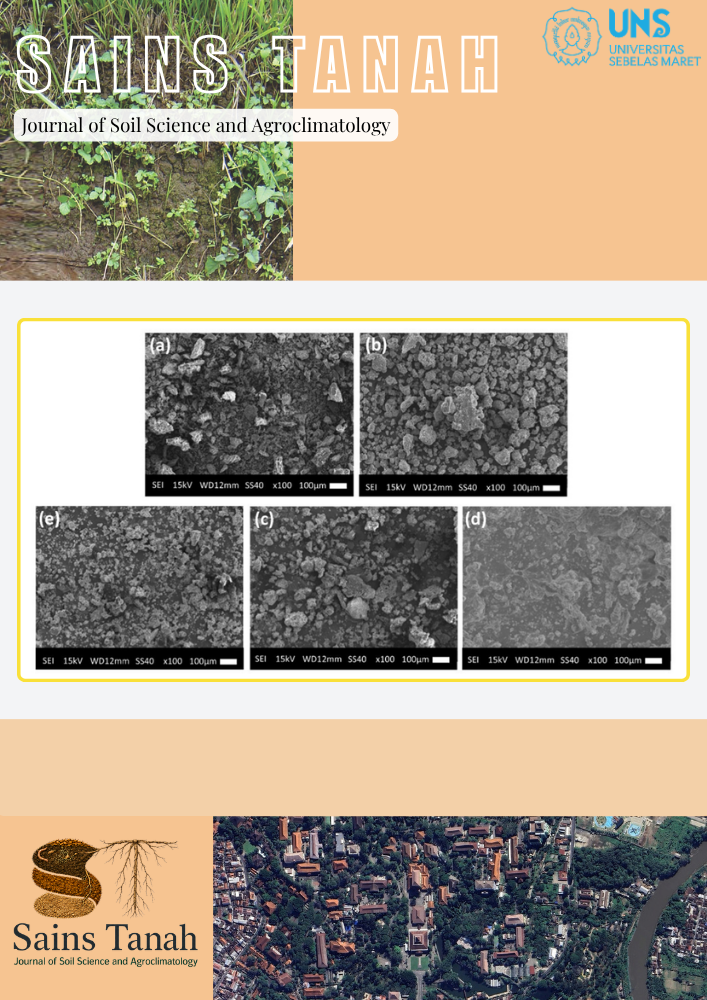
Studying the Solubility, Availability, and Uptake of Silicon (Si) from Some Ore Minerals in Sandy Soil

Downloads
Downloads
Badr, M. A. 2006. Efficiency of K-feldspar Combined with Organic Materials and Silicate Dissolving Bacteria on Tomato Yield. J Appl Sci Res. 2: 1191-1198.
Black, C. A. 1965. Methods of Soil Analysis. Part 2, Series 9, Am Soc. Agron. Inst. Publ., Madison, WI.: pp 894-1372.
Bocharnikova, E. A., Loginov, S. V., Matychenkova, V. V., Storozhenkob, P. A. 2010. Silicon Fertilizer Efficiency. Russ Agric Sci. 36: 446–448.
Bocharnikova, E. A., Matichenkova, V. V. 2012. Influence of plant associations on the silicon cycle in the soil-plant ecosystem. Appl Ecol Environ Res. 10: 547-560.
Boguta, P., D’Orazio, V., Sokołowska, Z., Senesi, N. 2016. Effects of selected chemical and physicochemical properties of humic acids from peat soils on their interaction mechanisms with copper ions at various pHs. J Geochem Explor. 168: 119-126.
Brigante, M., Zanini, G., Avena., M, 2010. Effect of humic acids on the adsorption of paraquat by goethite. J Hazard Mater. 184: 241–247.
Camargo, M. S.d., Amorim, L., Júnior, A. R. G. 2013. Silicon fertilisation decreases brown rust incidence in sugarcane. Crop Prot. 53: 72-79.
Cruz, M. F. A., Rodrigues, F. l. A., Diniz, A. P. C., Moreira, M. A., Barros, E. G. A. 2014. Soybean Resistance to Phakopsora pachyrhizi as Affected by Acibenzolar-S-Methyl, Jasmonic Acid, and Silicon. J Phytopathol. 162: 133–136.
Deshmukh, R. K., Vivancos, J., Gue´rin, V., Sonah, H., Labbe´, C., Belzile, F., Be´langer, R. 2013. Identification and functional characterization of silicon transporters in soybean using comparative genomics of major intrinsic proteins in Arabidopsis and rice. Plant Mol Biol. 83: 303–315.
Ehrlich, H., Demadis, K. D., Pokrovsky, O. S., Koutsoukos, P. G. 2010. Modern Views on Desilicification: Biosilica and Abiotic Silica Dissolution in Natural and Artificial Environments. Chem Rev. 110: 4656–4689.
FAO. 2014. World Reference Base for Soil Resources. A framework for international classification, correlation, and communication. Soil Taxonomy, Food and Agriculture Organization of the United Nations, Rome, Italy.
Gomez, K. A., Gomez, A. A. 1984. Statistical Procedures for Agricultural Research. John Wiley & Sons, New York, NY, USA: pp 8–20.
Gonzalo, M. J., Lucena, J. J., Hernández-Apaolaza, L. 2013. Effect of silicon addition on soybean (Glycine max L.) and cucumber (Cucumis sativus) plants grown under iron deficiency. Plant Physiol Biochem. 70: 455-461.
Heckman, J., Wolf, A. 2009. Recommended Soil Tests for Silicon, Chapter 12, Last Revised 10/2009. Cooperative Bull No 493: 99-102.
Jackson, M. L. 1973. Soil Chemical Analysis. Prentice-Hall, Inc., Englewood Califfs, New Jersy, USA: pp 429–464.
Ji, X., Liu, S., Huang, J., Bocharnikova, E., Matichenkova, V. 2016. Monosilicic acid potential in phytoremediation of the contaminated areas. Chemosphere 157: 132-136.
Júnior, J. A. A., Baldo, J. B. 2014. The Behavior of Zeta Potential of Silica Suspensions. New J Glass Ceram. 4: 29-37.
Li, C., Dong, Y., Wu, D., Peng, L., Kong, H. 2011. Surfactant modified zeolite as adsorbent for removal of humic acid from water. Appl Clay Sci. 52: 353–357.
Li, J., Wee, C., Sohn, B. 2013. Effect of Ammonium- and Potassium-Loaded Zeolite on Kale Growth and Soil Property. Amer J Plant Sci. 04(10): 1976-1982.
Liang, Y., Nikolic, M., Bélanger, R., Gong, H., Song, A. 2015. Silicon in agriculture: From theory to practice. Springer, Dordrecht: pp 5.
Matychenkova, I. V., Khomyakova, D. M., Pakhnenko, E. P., Bocharnikova, E. A., Matychenkova, V. V. 2016. Mobile Si-Rich Compounds in the Soilournal Instem and Methods for Their Determination. Moscow Univ Soil Sci Bull. 71 (3): 120sity S
Miyake, Y., Takahashi, E. 1985. Effect of Silicon on the Growth of Soybean Plants in a Solution Culture. Soil Sci. Plant Nutri. 31: 625-636.
Moriguchi, T., Yano, K., Tahara, M., Yaguchi, K. 2005. Metal-modified silica adsorbents for removal of humic substances in water. J Colloid Interface Sci. 283: 300–310.
Perez-Caballero, R., Gil, J., Benitez, C., Gonzalez, J. L. 2008. The effect of adding Zeolite to soils in order to Improve the N-K nutrition of olive trees. preliminary results. Amer. J Agric Biol Sci. 2: 321-324.
Rashad, R. T., Hussien, R. A. 2014. A comparison study on the effect of some growth regulators on the nutrients content of maize plant under salinity conditions. Ann Agric Sci. 59: 89–94.
Rodrigues, F. A., Datnoff, L. E. eds. 2015. Silicon and Plant Diseases. Springer: pp 141.
Rodrigues, L. L., Daroub, S. H., Rice, R. W., Snyder, G. H. 2003. Comparison of three soil test methods for estimating plant-available silicon. Commun Soil Sci Plant Anal. 34: 15-16.
Sarawade, P. B., Kim, J-K., Hilonga, A., Kim, H. T. 2010. Recovery of high surface area mesoporous silica from waste hexafluorosilicic acid (H2SiF6) of fertilizer industry. J Hazard Mater. 173: 576–580.
Savci, S. 2012. An Agricultural Pollutant: Chemical Fertilizer. Int J Environ Sci Dev. 3(1): 77-80.
Selim, M. E., El-Neklawy, A. S., El-Ashry, S. M. 2010. Beneficial Effects of Humic Substances on Soil Fertility to Fertigated Potato Grown on Sandy Soil. Libyan Agric Res Cent J Int. 1: 255-262.
Skorina, T., Allanore, A. 2015. Aqueous alteration of potassium-bearing aluminosilicate minerals: from mechanism to processing. Green Chem. 17: 2123-2136.
Smith, J. V. 1998. Atmospheric weathering and silica-coated feldspar: Analogy with zeolite molecular sieves, granite weathering, soil formation, ornamental slabs, and ceramics (architecture). Proceedings of the National academy of Sciences of the United States of America. Geology. 95: 3366–3369.
Snyder, G.H., Matichenkova, V.V., Datnoff, L.E. 2006. Handbook of Plant Nutrition. CRC Press, DK2972 Ch 19, Silicon, pp 551-568.
Sokolova, T. A. 2013. The destruction of quartz, amorphous silica minerals, and feldspars in model experiments and in soils: Possible mechanisms, rates, and diagnostics (the analysis of literature). Eurasian Soil Sci. 46: 91-105.
Wada, H. 2005. Managing sandy soils in Northeast Thailand. Management of Tropical Sandy Soils for Sustainable Agriculture “A holistic approach for sustainable development of problem soils in the tropics†Proceedings, 27th November – 2nd December, Khon Kaen, Thailand, Session 3 “Chemical properties and their effect on productivityâ€: pp 82-92.
Wiese, H., Nikolic, M., Römheld, V. 2007. Silicon in plant nutrition effects on zinc, manganese and boron leaf concentrations and compartmentation. Transport and Reactions, The Apoplast of Higher Plants: Compart Stor: pp 33–47.
Xie, W., Zhou, J., Wang, H., Liu, Q., Xia, J., Lv, X. 2011. Cu and Pb accumulation in maize (Zea mays L.) and soybean (Glycine max L.) as affected by N, P and K application. Afr J Agric Res. 6: 1469-1476.
- Authors retain copyright and grant the journal right of first publication with the work simultaneously licensed under a Creative Commons Attribution-NonCommercial License that allows others to Share (copy and redistribute the material in any medium or format) and Adapt (remix, transform, and build upon the material) the work non-commercially with an acknowledgement of the work's authorship and initial publication in this journal.
- Authors are able to enter into separate, additional contractual arrangements for the non-exclusive distribution of the journal's published version of the work (e.g., post it to an institutional repository or publish it in a book), with an acknowledgement of its initial publication in this journal.
- Authors are permitted and encouraged to post their work online (e.g., in institutional repositories or on their website) prior to and during the submission process, as it can lead to productive exchanges, as well as earlier and greater citation of published work (See The Effect of Open Access).