Application of pre-Terra Preta to enhance soil fertility and productivity of marginal land cultivated with Pennisetum purpureum cv. Mott

Downloads
Additional Files
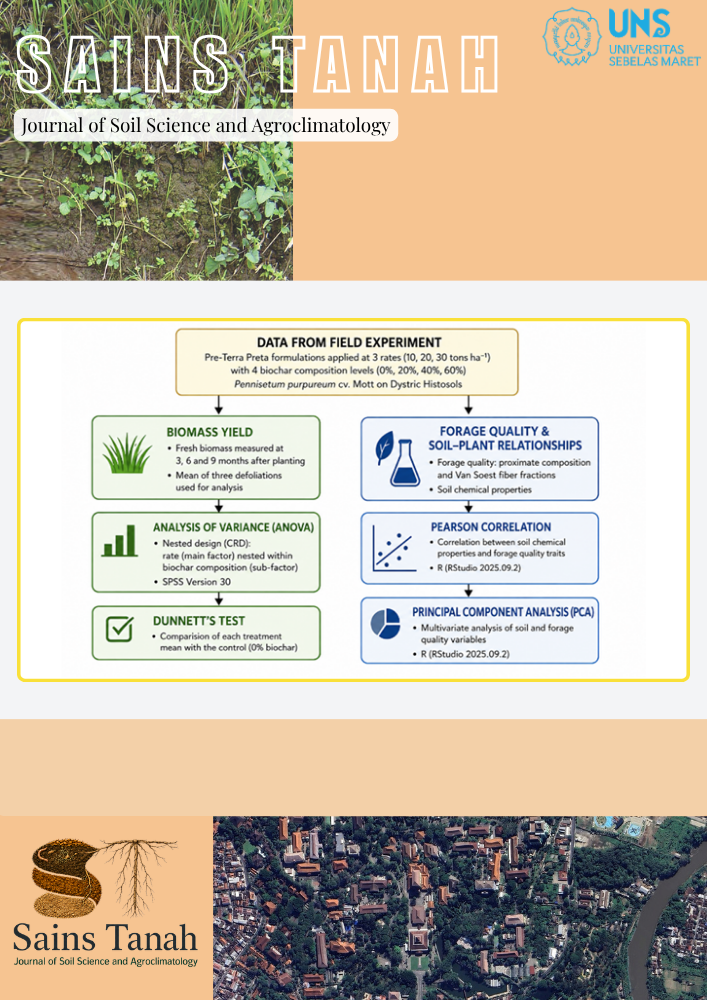
Indonesia’s national agriculture production is increasingly constrained by the expansion of marginal lands with low productivity, many of which have undergone severe degradation from mining and other land uses. These lands are characterized by low soil fertility and acidic pH, posing a challenge for sustainable forage production. This study investigates the application of pre-Terra Preta - a soil amendment composed of biochar, organic matter, animal manure, topsoil, and fermented microorganisms—to enhance the productivity of marginal land, using Pennisetum purpureum cv. Mott (Dwarf elephant grass) as a forage crop. The field experiment was conducted in Swarangan Village, Tanah Laut Regency, South Kalimantan, Indonesia. Soil chemical properties were analyzed before and after planting. A total of 36 plots (5 × 5 m) were treated with four levels of pre-Terra Preta biochar composition (0%, 20%, 40%, and 60%) and three application rates (10, 20, and 30 t haâ»Â¹). The results showed significant improvements in soil chemical properties, including total N (↑ 73.47%), organic C (↑ 35.20%), Kâ‚‚O (↑ 33.64%), and pH (↑ 148.89%). The optimal treatment—30 t haâ»Â¹ with 60% biochar—yielded the highest plant height (16.875 cm), number of leaves (12.900), and number of tillers (3.791). These differences were significant (p < 0.05), confirming the effectiveness of both biochar levels and application rates. Pre-Terra Preta offers a sustainable, cost-effective strategy for rehabilitating marginal lands in tropical regions. Further studies are recommended to assess long-term soil health, economic viability, forage quality, and livestock performance.
Downloads
Acharya, B. S., Dodla, S., Wang, J. J., Pavuluri, K., Darapuneni, M., Dattamudi, S., . . . Kharel, G. (2024). Biochar impacts on soil water dynamics: knowns, unknowns, and research directions. Biochar, 6(1), 34. https://doi.org/10.1007/s42773-024-00323-4
Ahmad Bhat, S., Kuriqi, A., Dar, M. U. D., Bhat, O., Sammen, S. S., Towfiqul Islam, A. R. M., . . . Heddam, S. (2022). Application of Biochar for Improving Physical, Chemical, and Hydrological Soil Properties: A Systematic Review. Sustainability, 14(17), 11104. https://doi.org/10.3390/su141711104
Ali, A., Jabeen, N., Chachar, Z., Chachar, S., Ahmed, S., Ahmed, N., . . . Yang, Z. (2025). The role of biochar in enhancing soil health & interactions with rhizosphere properties and enzyme activities in organic fertilizer substitution [Review]. Frontiers in Plant Science, Volume 16 - 2025. https://doi.org/10.3389/fpls.2025.1595208
Amelung, W., Bossio, D., de Vries, W., Kögel-Knabner, I., Lehmann, J., Amundson, R., . . . Chabbi, A. (2020). Towards a global-scale soil climate mitigation strategy. Nat Commun, 11(1), 5427. https://doi.org/10.1038/s41467-020-18887-7
Anda, M., Diah Purwantari, N., Yulistiani, D., Sajimin, Suryani, E., Husnain, & Agus, F. (2022). Reclamation of post-tin mining areas using forages: A strategy based on soil mineralogy, chemical properties and particle size of the refused materials. CATENA, 213, 106140. https://doi.org/10.1016/j.catena.2022.106140
Anjum, Z., Min, Q., Riaz, L., Waqar-Un-Nisa, Qadeer, S., & Saleem, A. R. (2022). Employment of Cannabis sativa biochar to improve soil nutrient pool and metal immobilization [Original Research]. Frontiers in Environmental Science, Volume 10 - 2022. https://doi.org/10.3389/fenvs.2022.1011820
Bezner Kerr, R., Postigo, J. C., Smith, P., Cowie, A., Singh, P. K., Rivera-Ferre, M., . . . Neufeldt, H. (2023). Agroecology as a transformative approach to tackle climatic, food, and ecosystemic crises. Current Opinion in Environmental Sustainability, 62, 101275. https://doi.org/10.1016/j.cosust.2023.101275
Brtnicky, M., Mustafa, A., Hammerschmiedt, T., Kintl, A., Trakal, L., Beesley, L., . . . Holatko, J. (2023). Pre-activated biochar by fertilizers mitigates nutrient leaching and stimulates soil microbial activity. Chemical and Biological Technologies in Agriculture, 10(1), 57. https://doi.org/10.1186/s40538-023-00430-7
BSN. (2024). Spesifikasi informasi geospasial: Survei dan pemetaan tanah semidetail skala 1:50.000. SNI 8473:2024. [Geospatial Information Specification: Semi-detailed Soil Survey and Mapping at a 1:50,000 Scale].
Burland, A., & von Cossel, M. (2023). Towards Managing Biodiversity of European Marginal Agricultural Land for Biodiversity-Friendly Biomass Production. Agronomy, 13(6), 1651. https://doi.org/10.3390/agronomy13061651
Chen, J., Yu, J., Li, Z., Zhou, J., & Zhan, L. (2023). Ameliorating Effects of Biochar, Sheep Manure and Chicken Manure on Acidified Purple Soil. Agronomy, 13(4), 1142. https://doi.org/10.3390/agronomy13041142
Csikós, N., & Tóth, G. (2023). Concepts of agricultural marginal lands and their utilisation: A review. Agricultural Systems, 204, 103560. https://doi.org/10.1016/j.agsy.2022.103560
de Lima, A. F. L., Campos, M. C. C., Martins, T. S., Silva, G. A., Brito, W. B. M., dos Santos, L. A. C., . . . da Cunha, J. M. (2022). Soil chemical attributes in areas under conversion from forest to pasture in southern Brazilian Amazon. Scientific Reports, 12(1), 22555. https://doi.org/10.1038/s41598-022-25406-9
FAO. (2021). The State of the World’s Land and Water Resources for Food and Agriculture – Systems at breaking point. Synthesis report 2021. Food and Agriculture Organization of the United Nations. https://doi.org/10.4060/cb7654en
FAO. (2023). Sustainable Development Goals. Guidelines for the Use of the SDG Logo, Including the Colour Wheel and 17 Icons. United Nations Department of Global Communications. https://unsdg.un.org/resources/guidelines-use-sdg-logo-including-colour-wheel-and-17-icons
Fritz, A.-L., Jannoura, R., Beuschel, R., Steiner, C., Buerkert, A., & Joergensen, R. G. (2022). The combined application of nitrogen and biochar reduced microbial carbon limitation in irrigated soils of West African urban horticulture. Chemical and Biological Technologies in Agriculture, 9(1), 48. https://doi.org/10.1186/s40538-022-00312-4
Gu, J., & Yang, J. (2022). Nitrogen (N) transformation in paddy rice field: Its effect on N uptake and relation to improved N management. Crop and Environment, 1(1), 7-14. https://doi.org/10.1016/j.crope.2022.03.003
Holatko, J., Bielska, L., Hammerschmiedt, T., Kucerik, J., Mustafa, A., Radziemska, M., . . . Brtnicky, M. (2022). Cattle Manure Fermented with Biochar and Humic Substances Improve the Crop Biomass, Microbiological Properties and Nutrient Status of Soil. Agronomy, 12(2), 368. https://doi.org/10.3390/agronomy12020368
Iacomino, G., Idbella, M., di Costanzo, L., Amoroso, G., Allevato, E., Abd-ElGawad, A. M., & Bonanomi, G. (2024). Biochar aging, soil microbiota and chemistry of charcoal kilns in Mediterranean forests. Biochar, 6(1), 82. https://doi.org/10.1007/s42773-024-00378-3
IUSS Working Group WRB. (2022). World Reference Base for Soil Resources. International soil classification system for naming soils and creating legends for soil maps. (4th ed.). International Union of Soil Sciences (IUSS), Vienna, Austria. https://files.isric.org/public/documents/WRB_fourth_edition_2022-12-18.pdf
Kern, J., Giani, L., Teixeira, W., Lanza, G., & Glaser, B. (2019). What can we learn from ancient fertile anthropic soil (Amazonian Dark Earths, shell mounds, Plaggen soil) for soil carbon sequestration? CATENA, 172, 104-112. https://doi.org/10.1016/j.catena.2018.08.008
KLHK. (2024). Laporan Kinerja Ditjen Pengelolaan Daerah Aliran Sungai dan Rehabilitasi Hutan tahun 2023 [Performance Report of the Directorate General of Watershed Management and Forest Rehabilitation for 2023] https://pdasrh.kehutanan.go.id/newsdetail.php?id=420-Laporan-Kinerja-Ditjen-Pengelolaan-Daerah-Aliran-Sungai-dan-Rehabilitasi-Hutan-tahun-2023
Kumar, P., & Choudhury, D. (2024). Chapter 21 - Role of indigenous knowledge in agricultural soil reclamation without disturbing other ecosystems. In P. Kumar, A. L. Srivastav, V. Chaudhary, E. D. van Hullebusch, & R. Busquets (Eds.), Bioremediation of Emerging Contaminants from Soils (pp. 465-488). Elsevier. https://doi.org/10.1016/B978-0-443-13993-2.00021-9
Kurniawan, W., Ramdani, A., Bain, A., Bachtiar, T., & Wahyono, T. (2022). Influences of manure and biochar on biomass yield and nutrient value of Pennisetum purpureum cv. Mott grown on post-nickel-mining soil. JAPS: Journal of Animal & Plant Sciences, 32(5). https://doi.org/10.36899/JAPS.2022.5.0537
Lal, R. (2020). Regenerative agriculture for food and climate. Journal of Soil and Water Conservation, 75(5), 123A-124A. https://doi.org/10.2489/jswc.2020.0620A
Li, Y., Feng, G., & Tewolde, H. (2023). Biochar derived from papermill factories improves soil physical and hydraulic properties in no-till cotton fields. Biochar, 5(1), 35. https://doi.org/10.1007/s42773-023-00235-9
Llovet, A., Vidal-Durà , A., Alcañiz, J. M., Ribas, A., & Domene, X. (2023). Biochar addition to organo-mineral fertilisers delays nutrient leaching and enhances barley nutrient content. Archives of Agronomy and Soil Science, 69(13), 2537-2551. https://doi.org/10.1080/03650340.2022.2161092
MartÃnez-Gómez, Ã., Poveda, J., & Escobar, C. (2022). Overview of the use of biochar from main cereals to stimulate plant growth [Review]. Frontiers in Plant Science, Volume 13 - 2022. https://doi.org/10.3389/fpls.2022.912264
Mawalla, D., & Gülser, C. (2023). İmpacts of biochar on tropical soil quality: A review. International Symposium on Soil Science & Plant Nutrition, 92-97. https://doi.org/10.5281/zenodo.11084425
Melo, L. C. A., & Sánchez-Monedero, M. Ã. (2024). How biochar-based fertilizers and biochar compost affect nutrient cycling and crop productivity. Nutrient Cycling in Agroecosystems, 128(3), 411-414. https://doi.org/10.1007/s10705-024-10358-5
Murtaza, G., Ahmed, Z., Eldin, S. M., Ali, B., Bawazeer, S., Usman, M., . . . Tariq, A. (2023). Biochar-Soil-Plant interactions: A cross talk for sustainable agriculture under changing climate [Review]. Frontiers in Environmental Science, Volume 11 - 2023. https://doi.org/10.3389/fenvs.2023.1059449
Mustafa, A., Holatko, J., Hammerschmiedt, T., Kucerik, J., Baltazar, T., Kintl, A., . . . Brtnicky, M. (2022). Unveiling the Impacts of Biochar, Manure and Their Optimal Combinations on Microbiological Soil Health Indicators and Lettuce Biomass. Agronomy, 12(10), 2307. https://doi.org/10.3390/agronomy12102307
Neina, D., & Agyarko-Mintah, E. (2023). The Terra Preta Model soil for sustainable sedentary yam production in West Africa. Heliyon, 9(5), e15896. https://doi.org/10.1016/j.heliyon.2023.e15896
Nepal, J., Ahmad, W., Munsif, F., Khan, A., & Zou, Z. (2023). Advances and prospects of biochar in improving soil fertility, biochemical quality, and environmental applications [Review]. Frontiers in Environmental Science, Volume 11 - 2023. https://doi.org/10.3389/fenvs.2023.1114752
Obayomi, O., Taggart, C. B., Zeng, S., Sefcik, K., Willis, B., Muir, J. P., . . . Brady, J. A. (2023). Dairy Manure-Derived Biochar in Soil Enhances Nutrient Metabolism and Soil Fertility, Altering the Soil Prokaryote Community. Agronomy, 13(6), 1512. https://doi.org/10.3390/agronomy13061512
Ollila, K., & Kotavaara, O. (2023). Measuring Accessibility and Optimising Logistics of Marginal Land Grass Biomass in the Case of Northern Ostrobothnia, Finland. European Countryside, 15(4), 542-562. https://doi.org/10.2478/euco-2023-0029
Orozco-Ortiz, J. M., Peña-Venegas, C. P., Bauke, S. L., Borgemeister, C., Mörchen, R., Lehndorff, E., & Amelung, W. (2021). Terra Preta Properties in Northwestern Amazonia (Colombia). Sustainability, 13(13), 7088. https://doi.org/10.3390/su13137088
Reza, M. S., Afroze, S., Bakar, M. S. A., Saidur, R., Aslfattahi, N., Taweekun, J., & Azad, A. K. (2020). Biochar characterization of invasive Pennisetum purpureum grass: effect of pyrolysis temperature. Biochar, 2(2), 239-251. https://doi.org/10.1007/s42773-020-00048-0
Sazali, N., Kettner, M., & Salim, N. (2025). Save the Planet 2.0: A Mini Review of Improving Agricultural Soil with Terra Preta. Journal of Advanced Research in Fluid Mechanics and Thermal Sciences, 126(2), 226-236. https://doi.org/10.37934/arfmts.126.2.226236
Singh, H., Northup, B. K., Rice, C. W., & Prasad, P. V. V. (2022). Biochar applications influence soil physical and chemical properties, microbial diversity, and crop productivity: a meta-analysis. Biochar, 4(1), 8. https://doi.org/10.1007/s42773-022-00138-1
Singh Yadav, S. P., Bhandari, S., Bhatta, D., Poudel, A., Bhattarai, S., Yadav, P., . . . Oli, B. (2023). Biochar application: A sustainable approach to improve soil health. Journal of Agriculture and Food Research, 11, 100498. https://doi.org/10.1016/j.jafr.2023.100498
Suwardi. (2025). 82 Persen Daratan Indonesia Lahan Marginal, Inovasi Teknologi Tanah Jadi Kunci Pemulihan. https://www.ipb.ac.id/News/Index/2025/08/Prof-Suwardi-82-Persen-Daratan-Indonesia-Lahan-Marginal-Inovasi-Teknologi-Tanah-Jadi-Kunci-Pemulihan/
Tang, E., Liao, W., & Thomas, S. C. (2023). Optimizing Biochar Particle Size for Plant Growth and Mitigation of Soil Salinization. Agronomy, 13(5), 1394. https://doi.org/10.3390/agronomy13051394
Xia, H., Liu, B., Riaz, M., Li, Y., Wang, X., Wang, J., & Jiang, C. (2022). 30-Month Pot Experiment: Biochar Alters Soil Potassium Forms, Soil Properties and Soil Fungal Diversity and Composition in Acidic Soil of Southern China. Plants, 11(24), 3442. https://doi.org/10.3390/plants11243442
Xu, P., Gao, Y., Cui, Z., Wu, B., Yan, B., Wang, Y., . . . Xue, W. (2023). Research Progress on Effects of Biochar on Soil Environment and Crop Nutrient Absorption and Utilization. Sustainability, 15(6), 4861. https://doi.org/10.3390/su15064861
Yang, Y., Hobbie, S. E., Hernandez, R. R., Fargione, J., Grodsky, S. M., Tilman, D., . . . Chen, W.-Q. (2020). Restoring Abandoned Farmland to Mitigate Climate Change on a Full Earth. One Earth, 3(2), 176-186. https://doi.org/10.1016/j.oneear.2020.07.019
Zhu, Z., Zhang, Y., Tao, W., Zhang, X., Xu, Z., & Xu, C. (2025). The Biological Effects of Biochar on Soil’s Physical and Chemical Characteristics: A Review. Sustainability, 17(5), 2214. https://doi.org/10.3390/su17052214
- Authors retain copyright and grant the journal right of first publication with the work simultaneously licensed under a Creative Commons Attribution-NonCommercial License that allows others to Share (copy and redistribute the material in any medium or format) and Adapt (remix, transform, and build upon the material) the work non-commercially with an acknowledgement of the work's authorship and initial publication in this journal.
- Authors are able to enter into separate, additional contractual arrangements for the non-exclusive distribution of the journal's published version of the work (e.g., post it to an institutional repository or publish it in a book), with an acknowledgement of its initial publication in this journal.
- Authors are permitted and encouraged to post their work online (e.g., in institutional repositories or on their website) prior to and during the submission process, as it can lead to productive exchanges, as well as earlier and greater citation of published work (See The Effect of Open Access).