







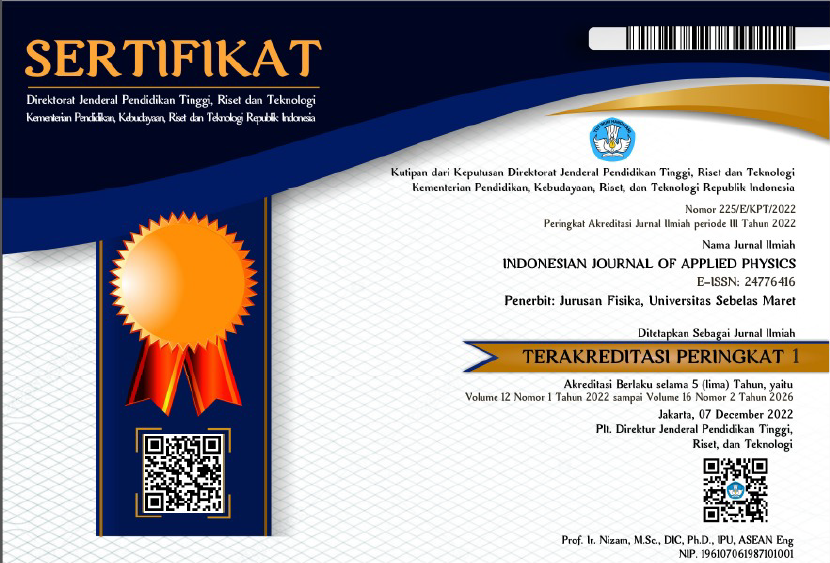







Calculating Ground State Energy of Helium by using Variational Monte Carlo Methods
Abstract
Variational Quantum Monte Carlo (VQMC) is a computational approach that combines the variational principle of quantum mechanics with stochastic Monte Carlo integration to estimate ground-state properties of many-body systems. In this study, the VQMC method is employed to calculate the ground-state energy of the helium atom, a fundamental two-electron system that serves as a benchmark for testing quantum methods. The evaluation of multidimensional integrals arising in the expectation value of the Hamiltonian is performed using importance sampling based on the Metropolis algorithm, which enhances computational efficiency and accuracy. A key advantage of the VQMC approach lies in its flexibility in selecting analytically tractable trial wave functions, enabling systematic improvement of results through parameter optimization. Using an appropriately constructed trial wave function that incorporates electron–electron correlation effects, the calculated ground-state energy of helium is found to be −77.645 eV. This result shows good agreement with the exact reference value, demonstrating that the VQMC method provides reliable and accurate estimations for atomic systems. The findings confirm the effectiveness of VQMC as a powerful tool for solving quantum many-body problems.
Keywords
Full Text:
PDFReferences
[1] Needs, R. J., Towler, M. D., Drummond, N. D., & López Ríos, P. (2020). Variational and diffusion quantum Monte Carlo calculations. The Journal of Chemical Physics, 152(15), 154106. https://doi.org/10.1063/1.5144288
[2] Booth, G. H., Thom, A. J. W., & Alavi, A. (2013). Fermion Monte Carlo without fixed nodes: A game of life, death, and annihilation in Slater determinant space. The Journal of Chemical Physics, 131(5), 054106. https://doi.org/10.1063/1.3193710
[3] Helgaker, T., Jørgensen, P., & Olsen, J. (2014). Molecular electronic-structure theory. Wiley
[4] Umrigar, C. J., Toulouse, J., Filippi, C., Sorella, S., & Hennig, R. G. (2017). Alleviation of the fermion-sign problem by optimization of many-body wave functions. Physical Review Letters, 98(11), 110201. https://doi.org/10.1103/PhysRevLett.98.110201
[5] Drummond, N. D., Towler, M. D., & Needs, R. J. (2018). Jastrow correlation factor for atoms, molecules, and solids. Physical Review B, 70(23), 235119. https://doi.org/10.1103/PhysRevB.70.235119
[6] Toulouse, J., & Umrigar, C. J. (2020). Optimization of quantum Monte Carlo wave functions by energy minimization. The Journal of Chemical Physics, 126(8), 084102. https://doi.org/10.1063/1.2437215
[7] Kato, T. (1957). On the eigenfunctions of many-particle systems in quantum mechanics. Communications on Pure and Applied Mathematics, 10(2), 151–177.
[8] Foulkes, W. M. C., Mitas, L., Needs, R. J., & Rajagopal, G. (2001). Quantum Monte Carlo simulations of solids. Reviews of Modern Physics, 73(1), 33–83. https://doi.org/10.1103/RevModPhys.73.33
[9] Metropolis, N., Rosenbluth, A., Rosenbluth, M., Teller, A., & Teller, E. (1953). Equation of state calculations. The Journal of Chemical Physics, 21(6), 1087–1092. http://dx.doi.org/10.1063/1.1699114
[10] Hastings, W. K. (1970). Monte Carlo sampling methods using Markov chains. Biometrika, 57(1), 97–109. https://doi.org/10.2307/2334940
[11] Flyvbjerg, H., & Petersen, H. G. (1989). Error estimates on averages of correlated data. The Journal of Chemical Physics, 91(1), 461–466. https://doi.org/10.1063/1.457480
[12] Sorella, S. (2005). Wave function optimization in the variational Monte Carlo method. Physical Review B, 71(24), 241103. https://doi.org/10.1103/PhysRevB.71.241103
[13] Griffith D.J.1992. Introduction to Quantum Mechanic, Second Edition, Person Prentice Hall.
[14] Montgomery Jr., et.al. (2010). The Ground State Energy of a helium Atom Under Strong Confinement, Physics Letters A 374, Elsevier, P. 2044-2047. https://doi.org/10.1016/j.physleta.2010.02.074
[15] Sulaiman, Ewa I.O.B. (2010). Variational quantum Monte Carlo of the ground state energy of hydrogen Molecule, BAJOPAS. 3.1, P. 112-117.
[16] Austin, B. M., Zubarev, D. Y., & Lester, W. A. (2012). Quantum Monte Carlo and related approaches. Chemical Reviews, 112(1), 263–288. https://pubs.acs.org/doi/10.1021/cr2001564
[17] Pfau, D., Spencer, J., Matthews, A., & Foulkes, W. (2020). Ab initio solution with neural networks. Physical Review Research, 2(3), 033429. https://doi.org/10.1103/PhysRevResearch.2.033429
[18] Hermann, J., Schätzle, Z. & Noé, F. Deep-neural-network solution of the electronic Schrödinger equation. Nat. Chem. 12, 891–897 (2020). https://doi.org/10.1038/s41557-020-0544-y
Refbacks
- There are currently no refbacks.
