










.png)
Focus and Scope
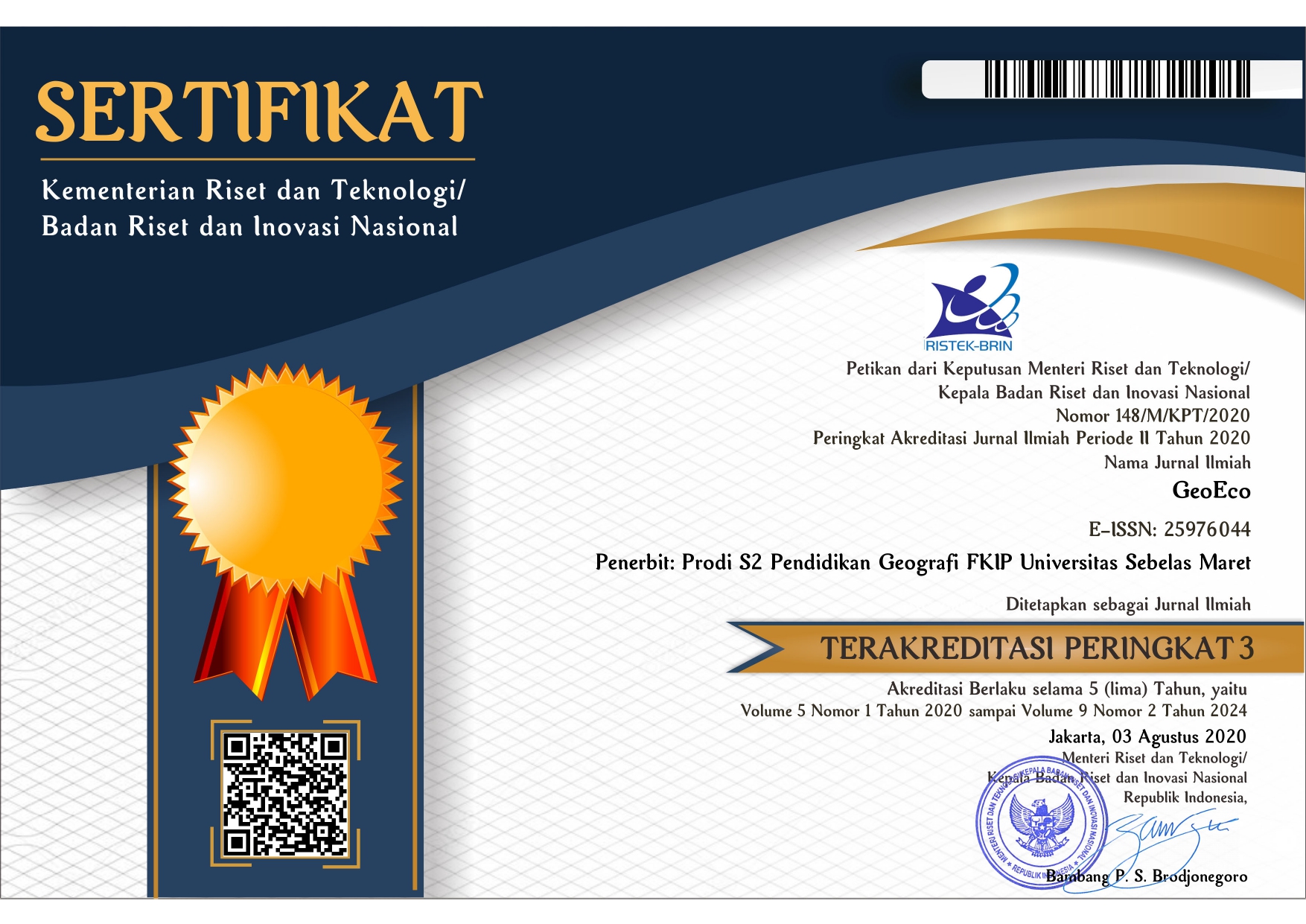
GeoEco is a journal covering all fields of education and science related to geography and the environment. The purpose of writing this journal are to reveal facts, problems and problem solving that can be used as input for Government, institutions, society and individual.The subject matter of the journal includes the following and related issues:
- Geography Education and Environment Education, including classroom action research results, experimental research, development research and survey research related to geography education in elementary, junior high, high school and university
- The phenomenon of the lithosphere, hydrosphere, atmosphere, anthroposphere, and its interaction with the population
- The phenomenon of disaster and their impacts to the nature and human
- Interaction between society, development and implication for sustainable development
- Sustainable use of land, water, energy and biological resources in development
- Social and cultural contexts of sustainable development
- Role of education and public awareness in sustainable development
- Sustainable development
GeoEco welcomes scientific research papers, review papers and discussion papers dealing with environmental sustainability, geography sciences, and geography education.
Section Policies
Articles
 Open Submissions Open Submissions |
Indexed |
Peer Reviewed |
Peer Review Process
- GeoEco Employs a double-blind peer-review method, namely that both reviewer's and author's (s) identities will be concealed from each other.
- Initial Screening. The Editor-in-Chief will screen all submitted manuscripts to determine whether the manuscript abides by the focus and scope of the Journal of GeoEco. Manuscripts that do not meet the basic requirements will be rejected without further review.
- If the manuscript meets these two criteria, it is checked for plagiarism or duplicate publication with a Similarity Check. After confirming its result, it is dispatched to two independent reviewers in the field with relevant knowledge.
- Peer-review. All manuscripts that pass the initial screening stage will be distributed to two experts in the relevant field to undergo a double-blind peer review.
- First Decision. A decision on a peer-reviewed manuscript will be given once both reviewers have submitted their review reports. If both reviewers have differing opinions about the manuscript, the final decision will be handed over to the Editor-in-Chief. At this stage, the author(s) will receive at least one of these decisions: accepted, revision required, or rejected.
- Revision Stage. Manuscripts recommended for revision will be returned to the submitting author. The author (s) will have up to 1 month to revise the manuscripts. The revision process will be limited to a maximum of two rounds.
- Final Decision. The manuscript will be rejected if the author(s) fails to meet the revision requirements after the second round. All accepted manuscripts will go through the final editing and layout process.
Publication Frequency
This journal is published one year twice in January and July.
Open Access Policy
This journal provides immediate open access to its content on the principle that making research freely available to the public supports a greater global exchange of knowledge.
Archiving
This journal utilizes the LOCKSS system to create a distributed archiving system among participating libraries and permits those libraries to create permanent archives of the journal for purposes of preservation and restoration. More...
Publication Ethics
[Based on Elsevier recommendations and COPE's Best Practice Guidelines for Journal Editors]
Ethical Guidelines for Journal Publication
The publication of an article in the peer-reviewed journals published by Faculty of Teacher Training and Education, Sebelas Maret University, Surakarta is process of permanent knowledge improvement. It is a direct reflection of the quality of the work of the authors and the institutions that support them. Peer-reviewed articles support and embody the scientific method. It is therefore important to agree upon standards of expected ethical behaviour for all parties involved in the act of publishing: the author, the journal editor, the peer reviewer, the publisher and the society of society-owned or sponsored journals.
Faculty of Teacher Training and Education, Sebelas Maret University, Surakarta takes their duties of guardianship over all stages of publishing extremely seriously and we recognise our ethical and other responsibilities.
We are committed to ensuring that advertising, reprint or other commercial revenue has no impact or influence on editorial decisions. In addition, Editorial Board will assist in communications with other journals and/or publishers where this is useful to editors.
1. Duties of Authors
a. Reporting standards
Authors of reports of original research should present an accurate account of the work performed as well as an objective discussion of its significance. Underlying data should be represented accurately in the paper. A paper should contain sufficient detail and references to permit others to replicate the work. Fraudulent or knowingly inaccurate statements constitute unethical behavior and are unacceptable. Review and professional publication articles should also be accurate and objective, and editorial 'opinion' works should be clearly identified as such.
b. Data access and retention
Authors may be asked to provide the raw data in connection with a paper for editorial review, and should in any event be prepared to retain such data for a reasonable time after publication.
c. Originality and plagiarism
The authors should ensure that they have written entirely original works, and if the authors have used the work and/or words of others, that this has been appropriately cited or quoted. Plagiarism takes many forms, from 'passing off' another's paper as the author's own paper, to copying or paraphrasing substantial parts of another's paper (without attribution), to claiming results from research conducted by others. Plagiarism in all its forms constitutes unethical publishing behavior and is unacceptable.
d. Multiple, redundant or concurrent publication
An author should not in general publish manuscripts describing essentially the same research in more than one journal or primary publication. Submitting the same manuscript to more than one journal concurrently constitutes unethical publishing behavior and is unacceptable. In general, an author should not submit for consideration in another journal a previously published paper.
e. Acknowledgement of sources
Proper acknowledgment of the work of others must always be given. Authors should cite publications that have been influential in determining the nature of the reported work. Information obtained privately, as in conversation, correspondence, or discussion with third parties, must not be used or reported without explicit, written permission from the source. Information obtained in the course of confidential services, such as refereeing manuscripts or grant applications, must not be used without the explicit written permission of the author of the work involved in these services.
f. Authorship of the paper
Authorship should be limited to those who have made a significant contribution to the conception, design, execution, or interpretation of the reported study. All those who have made significant contributions should be listed as co-authors. Where there are others who have participated in certain substantive aspects of the research project, they should be acknowledged or listed as contributors. The corresponding author should ensure that all co-authors have seen and approved the final version of the paper and have agreed to its submission for publication.
g. Hazards and human or animal subjects
If the work involves chemicals, procedures or equipment that have any unusual hazards inherent in their use, the author must clearly identify these in the manuscript. If the work involves the use of animal or human subjects, the author should ensure that the manuscript contains a statement that all procedures were performed in compliance with relevant laws and institutional guidelines and that the appropriate institutional committee(s) has approved them. Authors should include a statement in the manuscript that informed consent was obtained for experimentation with human subjects. The privacy rights of human subjects must always be observed.
h. Disclosure and conflicts of interest
All authors should disclose in their manuscript any financial or other substantive conflict of interest that might be construed to influence the results or interpretation of their manuscript. All sources of financial support for the project should be disclosed. Examples of potential conflicts of interest which should be disclosed include employment, consultancies, stock ownership, honoraria, paid expert testimony, patent applications/registrations, and grants or other funding. Potential conflicts of interest should be disclosed at the earliest stage possible.
i. Fundamental errors in published works
When an author discovers a significant error or inaccuracy in his/her own published work, it is the author's obligation to promptly notify the journal editor or publisher and cooperate with the editor to retract or correct the paper. If the editor or the publisher learns from a third party that a published work contains a significant error, it is the obligation of the author to promptly retract or correct the paper or provide evidence to the editor of the correctness of the original paper.
2. Duties of Editors
a. Publication decisions
The editor of a peer-reviewed journal is responsible for deciding which of the articles submitted to the journal should be published, often working in conjunction with the relevant society (for society-owned or sponsored journals). The validation of the work in question and its importance to researchers and readers must always drive such decisions. The editor may be guided by the policies of the journal's editorial board and constrained by such legal requirements as shall then be in force regarding libel, copyright infringement and plagiarism. The editor may confer with other editors or reviewers (or society officers) in making this decision.
b. Fair play
An editor should evaluate manuscripts for their intellectual content without regard to race, gender, sexual orientation, religious belief, ethnic origin, citizenship, or political philosophy of the authors.
c. Confidentiality
The editor and any editorial staff must not disclose any information about a submitted manuscript to anyone other than the corresponding author, reviewers, potential reviewers, other editorial advisers, and the publisher, as appropriate.
d. Disclosure and conflicts of interest
Unpublished information and materials obtained through the editorial or peer-review process must be kept confidential and must not be used for personal or research purposes without the author's permission.
Editors must disclose and manage any conflicts of interest and recuse themselves from handling manuscripts involving personal, professional, competitive, collaborative, or institutional relationships that may affect editorial impartiality.
Authors and relevant contributors must disclose competing interests. If a relevant conflict is subsequently identified or inadequately disclosed, the journal may take appropriate action, including issuing a correction or editorial notice.
3. Complaints and Appeals
GeoEco provides a transparent mechanism for handling complaints and appeals concerning editorial decisions, peer review, editorial conduct, or publication procedures.
Authors may appeal an editorial decision by submitting a written explanation to the Editor-in-Chief, clearly stating the grounds for the appeal and providing relevant supporting information. Appeals will be reviewed by the Editor-in-Chief or by an independent editor who was not involved in the original decision. Complaints concerning editors, reviewers, or editorial processes will be handled fairly and confidentially. Where appropriate, the journal may seek advice from independent experts, the publisher, or the relevant institution.The decision following an appeal will be communicated to the appellant and will normally be considered final.
4. Citation Manipulation
GeoEco does not permit citation manipulation. Authors, reviewers, and editors must not request or require citations solely to increase citation counts, journal metrics, author metrics, or other forms of academic impact. Citations must be relevant and academically justified. Unnecessary self-citation, excessive journal self-citation, or coordinated citation practices intended to artificially increase citation metrics are considered unethical
5. Peer Review Manipulation
GeoEco prohibits manipulation of the peer review process. Authors must provide accurate information when suggesting potential reviewers. Fabricated, false, misleading, or manipulated reviewer identities or contact information are not permitted. Reviewers and editors must conduct peer review independently and maintain confidentiality. Any suspected manipulation of the peer review process will be investigated and may result in rejection, withdrawal, or other appropriate editorial action.
Plagiarism Check
To check the possibility of plagiarism manuscript is submitted using the application Turnitin. The maximum similarity rate allowed in GeoEco is 25 %.
Generative Artificial Intelligence (AI) Policy
Generative AI and AI-Assisted Technologies Policy
To maintain academic integrity and ensure responsible use of technology, GeoEco adopts the following policy regarding the use of Generative Artificial Intelligence (AI) and AI-assisted tools in manuscript preparation, analysis, and review.
1. Transparency and Disclosure
Authors must disclose any use of Generative AI or AI-assisted technologies in the manuscript. The use of AI should be described in the relevant section of the manuscript, particularly in the Methods section when applicable. Authors should specify:
- The tool(s) used
- The purpose of use (e.g., language editing, figure creation, coding assistance)
- The scope and extent of assistance
Undisclosed use of AI tools may be considered a breach of publication ethics.
2. AI Cannot Be Listed as an Author
Generative AI tools cannot be credited as authors, co-authors, contributors, or correspondents.
Only humans with verifiable intellectual contributions may be listed as authors.
3. Responsibility and Accountability
Authors bear full responsibility for:
- The accuracy and validity of all content generated with or assisted by AI
- Checking for errors, fabricated information, incorrect citations, or biased outputs
- Ensuring that text, data, figures, or code produced with AI do not infringe copyright or ethical standards
The journal will not accept manuscripts containing unverifiable or fabricated data produced by AI tools.
4. Restrictions on AI-Generated Content
AI tools may be used for:
- Grammar correction and language refinement
- Drafting text that is then substantially revised by the author
- Figure enhancement, image clarity improvement, or aesthetic editing
- Data analysis assistance (e.g., coding help), where authors retain full control and verify results
AI tools may NOT be used for:
- Generating research data, experimental results, or statistical outcomes
- Fabricating citations or literature summaries
- Producing images or figures that may misrepresent scientific findings
- Writing substantial sections of the manuscript without human revision
- Peer review reports or confidential material assessment
5. Data, Images, and Figure Integrity
All data, images, and figures must reflect factual and verifiable results.
If image-editing AI tools are used (e.g., to improve brightness, clarity, or color), authors must ensure that:
- No scientific information is altered
- No manipulation misleads interpretation
6. AI Use by Reviewers and Editors
Reviewers and editors must NOT use Generative AI tools to analyze, summarize, or provide feedback on confidential manuscripts.
AI tools may only be used for non-confidential tasks such as grammar checking or non-sensitive text drafting.
7. Ethical Considerations
Misuse of AI tools—such as generating false data, misrepresenting findings, or failing to disclose AI use—may lead to:
- Manuscript rejection
- Retraction after publication
- Reporting to the authors’ institution
Future submission restrictions
8. Effective Date
This policy applies to all manuscripts submitted to GeoEco from Volume 13, No. 1 (2027) onward. Manuscripts submitted before Volume 13, No. 1 (2027) will be subject to the AI policy in effect at the time of submission.

